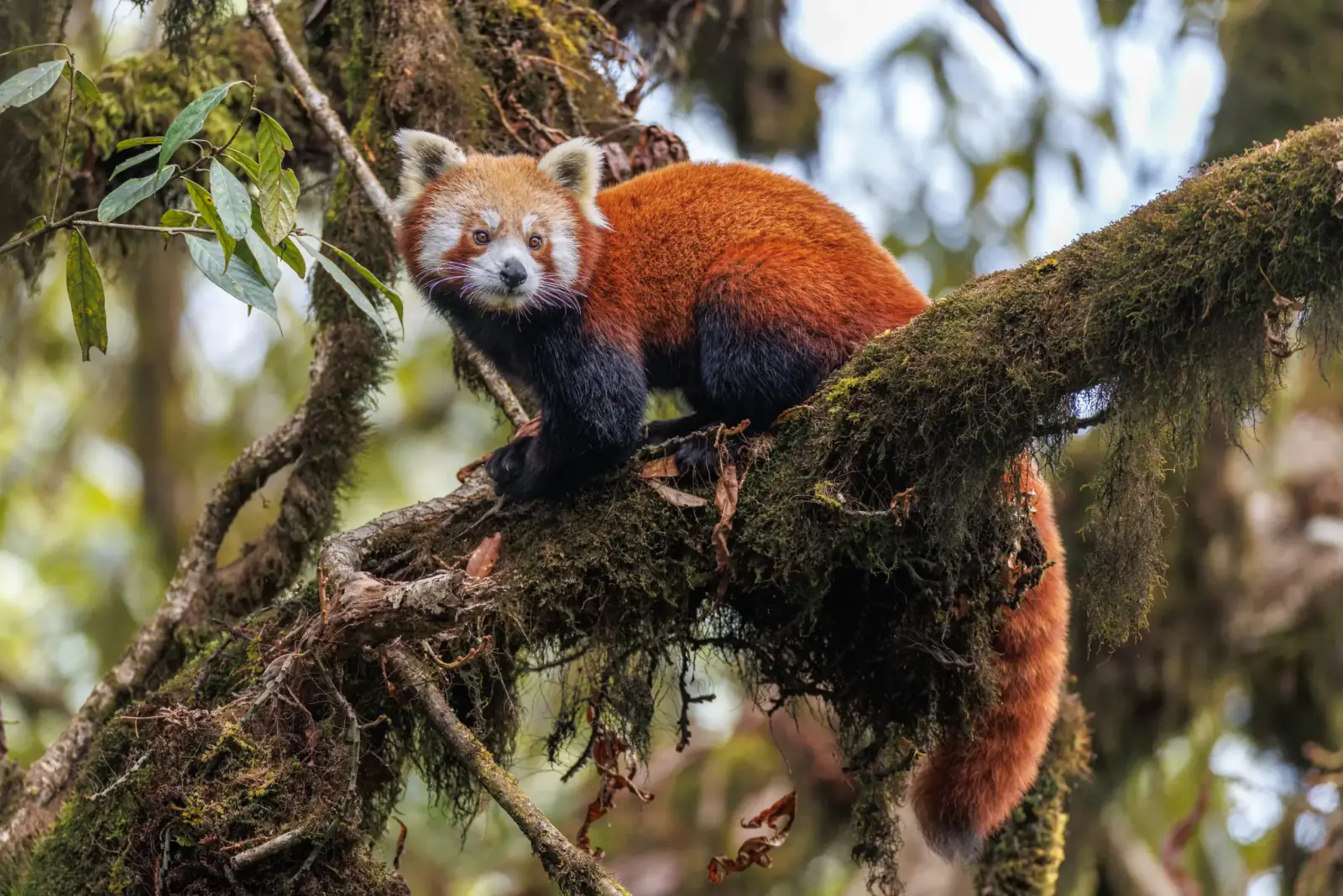
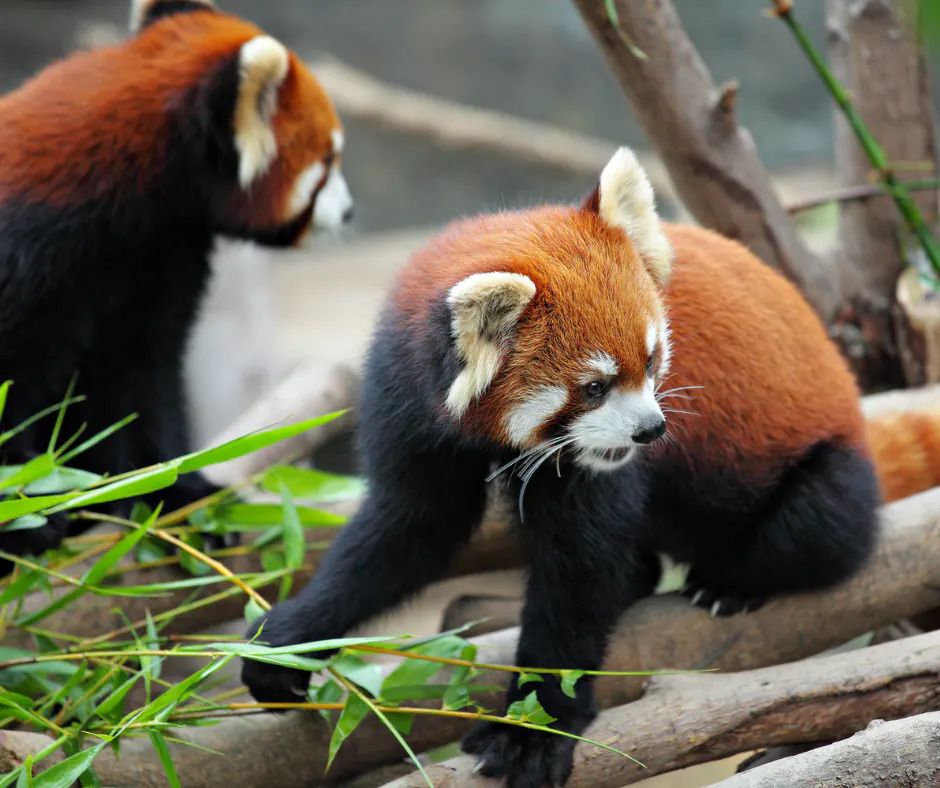
The frost on the bamboo leaves crunches softly underfoot, the only sound in the high-altitude silence of the Singalila ridge. It is 5:30 AM, and the air at 10,000 feet is sharp and biting. Through the dense, lingering mist, the gnarled trunks of ancient rhododendron trees emerge like shadows. We move slowly, communicating only through hand signals, our eyes scanning the dense mid-canopy. Tracking here is an exercise in extreme patience and absolute quiet. You are not looking for a large silhouette; you are looking for an anomaly in the texture of the forest, a subtle rustle in the bamboo, or a patch of rust-red fur glowing faintly against the deep green moss. Suddenly, our local tracker stops and points upward. There, draped perfectly across a lichen-covered branch, thirty feet above the forest floor, a wild red panda turns its head to look down at us. Its breath catches in the freezing air. This is not a zoo enclosure or a nature park. This is the wild Eastern Himalaya, and you have just earned one of the rarest wildlife sightings on earth.
Table of Contents
Why Singalila Is One of the Best Places on Earth to See Wild Red Pandas
To understand why Singalila National Park is a global stronghold for the red panda (Ailurus fulgens), you must first understand the severe geographical requirements of the species. Red pandas are obligate inhabitants of temperate Himalayan broadleaf and conifer forests, specifically those sitting at elevations between 7,000 and 12,000 feet. They require a very specific microclimate: cool temperatures, high humidity, and, most importantly, an unbroken understorey of bamboo.
Singalila delivers this exact ecosystem in abundance. Straddling the high ridges that form the porous border between India (West Bengal and Sikkim) and Nepal, the park is a primeval cloud forest. It is dominated by towering Himalayan oaks, silver firs, and sprawling rhododendrons that explode into bloom in the spring. Beneath this towering canopy lies a dense, nearly impenetrable thicket of Arundinaria bamboo. This multi-layered forest structure provides the red panda with everything it needs: endless food in the understorey, and high, moss-draped branches in the canopy for safe, insulated resting.
What makes Singalila uniquely suited for tracking, compared to other Himalayan habitats, is its topography and accessibility. The park is traversed by the Singalila Ridge trail, a historic trekking route that cuts directly through prime red panda habitat. Instead of having to hack through uncharted, vertical jungles, naturalists and trackers can use these established ridge trails to quietly access deep forest zones.
Despite its ecological importance, Singalila remains a hidden gem in the Indian wildlife circuit. The vast majority of wildlife tourism in India is hyper-focused on the central Indian tiger reserves or the snow leopard expeditions in the stark deserts of Ladakh. The Eastern Himalaya is often bypassed entirely by mainstream operators. Because few operators have invested the time to understand this specific terrain or build relationships with the indigenous tracking networks, the ecosystem remains remarkably undisturbed by mass tourism. When you track in Singalila, you are often the only expedition in the valley, claiming a space in a pristine wilderness that feels entirely your own.
Understanding Red Panda Behaviour and Ecology
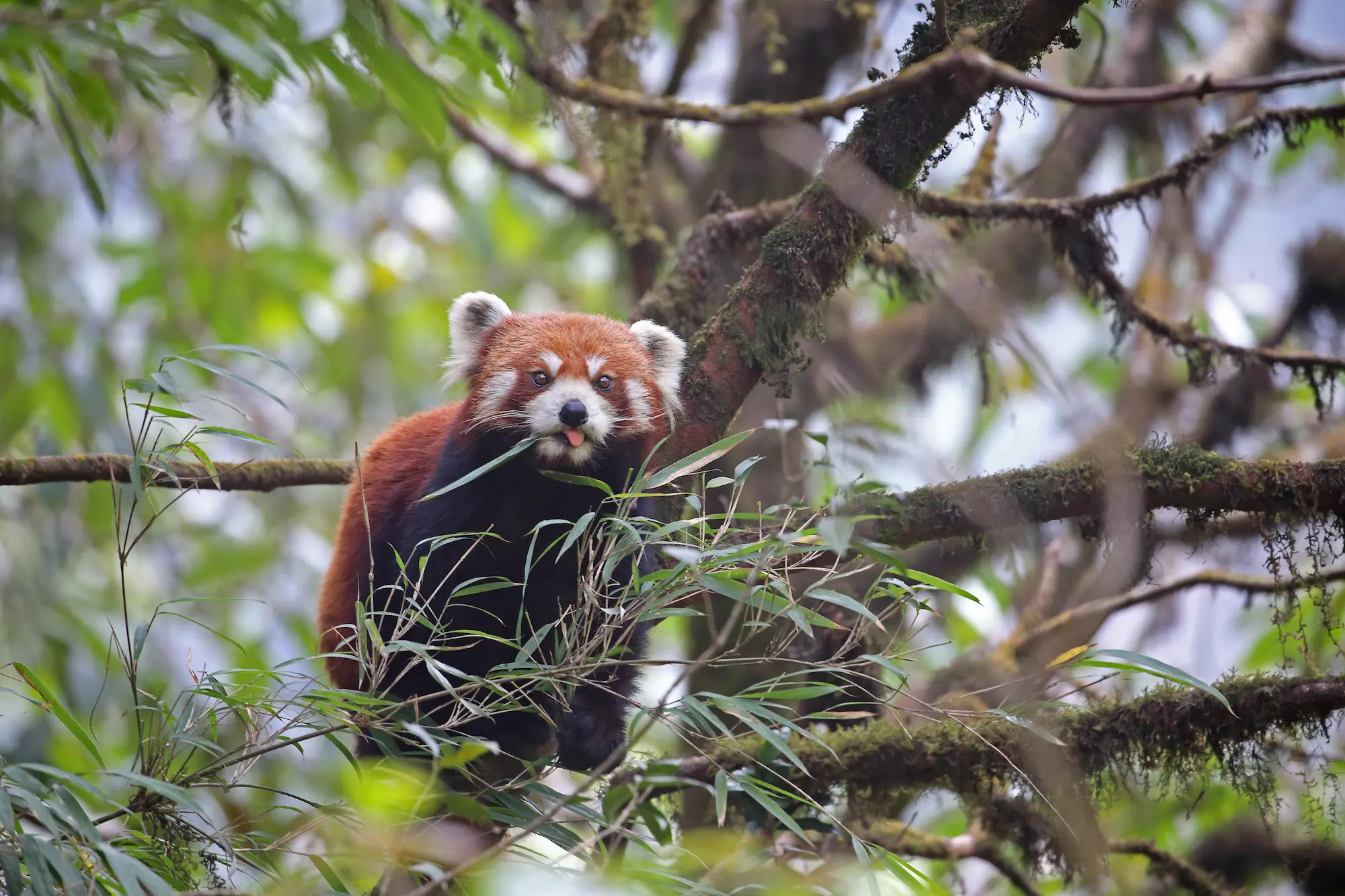
The red panda is an evolutionary outlier, the only living member of the family Ailuridae. Despite sharing a name and a bamboo diet with the giant panda, they are not closely related. They are solitary, highly arboreal creatures built for a life suspended in the canopy. Their semi-retractable claws allow them to descend trees head-first, a rare trait among mammals, and their long, heavily ringed tails act as vital counterbalances while navigating precarious branches, as well as thick blankets wrapped around their faces during sub-zero nights.
Their ecology is entirely dictated by their diet. A red panda’s diet is up to 98% bamboo, specifically the tender leaves and shoots. Bamboo is incredibly low in calories and difficult to digest. To extract enough energy to survive the freezing Himalayan winter, a red panda must consume up to thirty percent of its body weight in bamboo every single day. This metabolic constraint defines their behaviour. They are not highly active, bounding animals; they are deliberate and energy-conservative.
They are primarily crepuscular, meaning their activity peaks during the twilight hours of dawn and dusk. During the middle of the day, especially in colder months, they conserve energy by sleeping high in the canopy, often draped over a branch, seeking patches of direct sunlight to thermoregulate without expending calories.
Tracking a species that spends most of its time sleeping high in dense foliage requires a complete departure from standard safari techniques. You do not drive around looking for a red panda; you walk slowly, reading the subtle signs they leave behind. Our naturalists and local trackers look at the ground as much as the canopy. We search for fresh scat on the trail edges. Red panda droppings are distinctive, green, and highly fibrous, looking almost like compressed bamboo pulp.
We examine the trunks of large oak and rhododendron trees. A tree frequently used by a red panda will show fresh, pale claw marks cutting through the thick layer of green moss and lichen that coats the bark. We also look for feeding signs: specific patterns of stripped bamboo leaves at a certain height. Finally, we rely heavily on acoustics. The forest telegraph system is incredibly accurate. The frantic, high-pitched alarm calls of high-altitude bird species, or the sudden chattering of a Himalayan giant squirrel, often indicate a predator moving through the canopy, sometimes a yellow-throated marten or a leopard, but frequently, a foraging red panda.
Best Time to Track Red Pandas in Singalila
In the high Himalaya, the seasons dictate your success entirely. During the summer monsoon (June to September), Singalila receives punishing, torrential rainfall. The forest becomes a saturated sponge, leeches blanket the trails, and the dense, revitalized foliage makes visibility virtually zero. Tracking during the monsoon is largely impossible and highly discouraged.
The tracking window opens in October as the monsoon withdraws, but the prime conditions arrive in late autumn and persist through the winter. This is why our highly specialized fixed departure is scheduled for November 12–16.
November in Singalila is extraordinary. The heavy monsoon clouds finally break, leaving behind crisp, incredibly clear skies that offer uninterrupted, panoramic views of Kangchenjunga, the third highest mountain in the world, and occasionally even Mount Everest in the far distance.
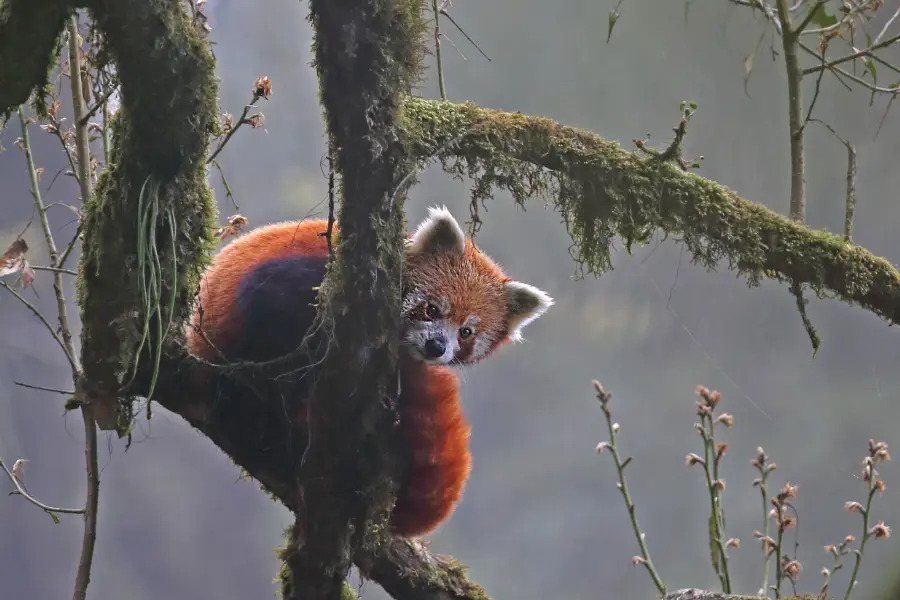
Crucially, November brings a significant drop in temperature. As the biting cold sets in, the behavioural patterns of the red panda shift in our favour. To conserve body heat and thermoregulate, red pandas spend more time during the daylight hours seeking out patches of direct sunlight. Instead of sleeping deep within the shadowy recesses of the bamboo thicket, they climb higher into the leafless branches of deciduous trees or rest on exposed, sunlit limbs of giant oaks. This specific sunbathing behaviour pulls them out of the dense undergrowth and into the open, making them significantly easier to locate with spotting scopes and binoculars from the ridge trails.
The autumn also aligns with the post-monsoon fruiting of certain mountain berries, which the pandas occasionally consume to supplement their bamboo diet, drawing them to specific, predictable fruiting trees. By timing the expedition for mid-November, we position our guests in the absolute sweet spot of clear visibility, predictable animal behaviour, and stunning Himalayan weather.
The Expedition Experience
If your baseline for a wildlife tour is sitting in the back of an open gypsy in Bandhavgarh or Ranthambore, tracking in Singalila requires a complete mental reset. This is not a passive safari; it is an active, immersive alpine expedition. There are no jeeps in the core tracking zones. Your feet are your transport, and your patience is your greatest asset.
A typical day begins long before the sun hits the ridge. You wake in the pre-dawn darkness, the temperature likely hovering near freezing. After layering up in thermal gear and sharing a steaming cup of Darjeeling tea, you step out onto the trail. The silence of the cloud forest at 5:00 AM is absolute, broken only by the crunch of frost under your boots and the occasional call of a laughingthrush.
We move in a tight, small group, maintaining strict silence. The trails in Singalila follow the undulating contours of the ridges, meaning you are constantly gaining and losing elevation. The pace is intentionally slow, not just to manage the effects of the altitude, but because speed is the enemy of observation.
Our naturalists and local spotters walk ahead, constantly scanning the terrain. When a fresh sign is found (a cluster of scat or a newly moss-stripped trunk), the expedition halts. This is where the true tracking happens. We set up high-powered spotting scopes and begin systematically dismantling the canopy visually. You will spend hours standing on cold ridges, your eyes strained against the binoculars, learning how to separate the reddish-brown of a peeling birch bark from the rust-red fur of a sleeping panda.
The reward for this intense physical and mental focus is profound. When a sighting occurs, there is no chaotic convergence of twenty tourist vehicles. It is just your small group, standing quietly in the mist, watching a wild red panda slowly strip bamboo leaves or groom its magnificent tail. You have the time and the silence to observe genuine, undisturbed behaviour. This slow, deliberate engagement with the ecosystem is the defining characteristic of a Just Nature expedition.
Who Leads This Expedition
The difference between a frustrating trek and a successful wildlife expedition comes down entirely to the expertise of the personnel on the ground. In Singalila, you cannot simply hire a trekking guide and expect to find a red panda. You need specialists.
Our expeditions are led by seasoned field naturalists. As the founder of Just Nature Expeditions, my background as an ornithologist and my seven years as head naturalist at Reni Pani Jungle Lodge dictate our approach. We do not employ "guides" whose sole job is to point at an animal and name it. We employ naturalists who interpret the entire ecosystem. As we walk, we will explain the symbiotic relationship between the oak trees and the moss, identify the endemic high-altitude birdlife, and break down the evolutionary biology of the species we are tracking.
Crucially, our naturalists operate in seamless partnership with elite local trackers from the border villages of Singalila. These indigenous trackers have spent their entire lives navigating these ridges. Their eyes are remarkably attuned to the specific visual anomalies of the forest, and their understanding of the local micro-movements of the red pandas is unparalleled. We combine this localized, generational tracking intuition with our broader scientific understanding and strict wildlife ethics, ensuring a world-class observation experience that respects the wilderness.
Who This Expedition Is For
The Serious Wildlife Enthusiast
You have explored the central Indian tiger reserves and perhaps tracked leopards in Kabini or Jawai. You understand the mechanics of a standard safari, but you are now seeking something rarer, more challenging, and less commercialized. You are frustrated by operators who treat wildlife viewing as a chaotic checklist. You want to walk the habitat, understand the prey dynamics, and learn the science behind the tracking. You appreciate that in dense cloud forests, a sighting is never guaranteed, but must be earned through patience and expert fieldcraft. You want the time and the ethical distance to photograph an apex species without altering its behaviour. Here, you will find a team that speaks your language and shares your obsessive dedication to the wild.
The Bucket List Adventurer
You might have only seen a red panda on a wildlife documentary or in a zoological park, and the realization that you can track them in the wild in India feels like a revelation. You may not be a hardcore biologist, but you crave authentic, frontier experiences. You might feel slightly apprehensive about the cold, the altitude, or the physical demands of trekking. Our expedition is designed to support you entirely. We manage the complex logistics flawlessly, provide clear guidance on layering and gear, and set a manageable, deliberate pace on the trails. You only need to bring a resilient mindset, a willingness to wake up early, and a deep respect for the mountains. We will handle the rest, guiding you safely into one of the most magical ecosystems on the planet.
Practical Details
Altitude and Fitness Expectations: Singalila National Park sits at a high elevation, with tracking zones typically ranging between 7,000 and 10,000 feet. At this altitude, the air is noticeably thinner. While you do not need to be an elite mountaineer, a solid baseline of cardiovascular fitness is required. You must be comfortable walking for several hours on undulating, sometimes steep, and potentially muddy forest trails. We manage the altitude by enforcing a slow, deliberate walking pace and prioritizing acclimatization, but guests must be prepared for physical exertion.
Extreme Weather Gear: The weather in the Eastern Himalaya is highly unpredictable. In November, daytime temperatures can be pleasant in the sun, but pre-dawn and evening temperatures frequently drop to freezing. A comprehensive layering system is non-negotiable. You must pack high-quality thermal base layers, heavy fleece mid-layers, and a windproof, waterproof outer shell. Heavy-duty, broken-in trekking boots with excellent ankle support and grip are essential, as the trails can be slick with frost or residual moisture.
Logistics and Accommodation: Accessing Singalila requires careful logistical planning. Expeditions typically begin with an arrival at Bagdogra Airport (IXB), followed by a drive up through the tea estates of Darjeeling to our designated base camps on the edge of the national park. [NEEDS INPUT: Specific accommodation details, e.g., Habre's Nest or specific homestays, and exactly what level of comfort guests should expect]. We manage all internal transfers, permits, and park fees, allowing you to focus entirely on the tracking experience.
Small-Group Ethos: We strictly cap our red panda tracking groups. This is a fundamental conservation principle. A large, noisy group cannot successfully track in a dense bamboo forest without spooking the wildlife and destroying the experience. Keeping the group small ensures we move silently, leave minimal impact on the fragile alpine ecosystem, and provide you with intimate, one-on-one access to our naturalists.
Frequently Asked Questions
Can you see wild red pandas in India?
Who offers red panda tracking expeditions in Singalila?
What is the best time of year to see red pandas in Singalila National Park?
How difficult is red panda tracking in Singalila?
How likely am I to actually see a red panda in the wild?
What gear do I need for a red panda expedition?