
I have been asked this question more times than I can count, usually by someone sitting across from me after a slide show, or in a WhatsApp message at eleven at night. "Spiti or Ladakh?" It is not a small question. Both are extraordinary. Both will test you. And the honest answer, which I have arrived at after running expeditions in both places across multiple seasons, is that the right destination depends entirely on who you are as a traveller - and what kind of experience you are actually looking for.
This comparison is my attempt to give you a straight answer. Not a rankings article, not a "which is better" clickbait piece. Just the field reality of two different landscapes, two different tracking environments, and two different expeditions - written by someone who has been cold in both of them.
Table of Contents
The Short Answer
Both destinations have a Just Nature departure in the 2027 season - Ladakh: February 1–10 and Spiti: March 7–16. What follows is the detail behind that short answer, so you can make the right call for yourself.
Understanding the Two Landscapes
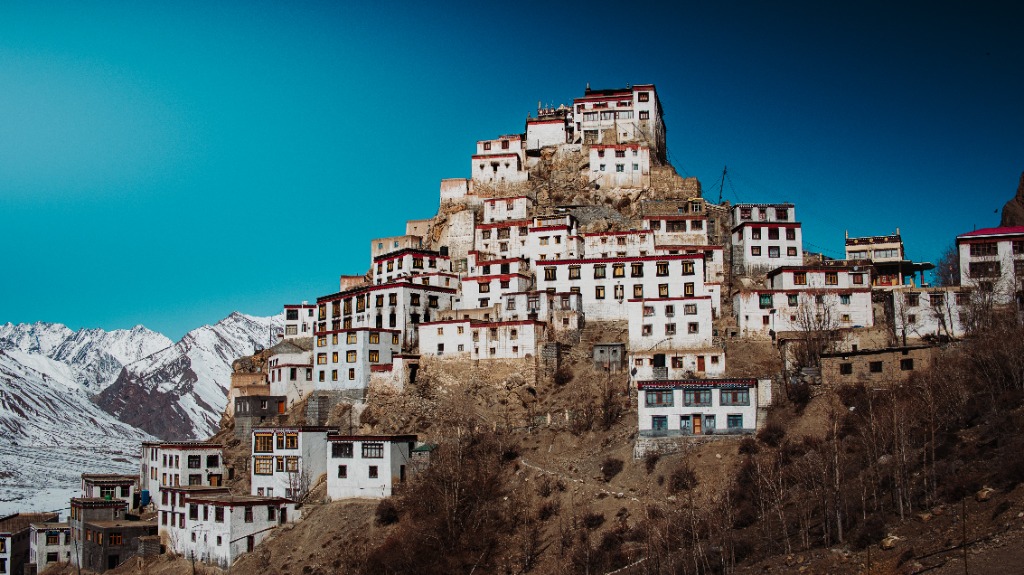
Spiti Valley Kibber, 4,270m
The valley faces are wide, almost theatrical in scale. From the ridgelines above Kibber, you can see kilometres of open snowfield in every direction - rock faces so exposed and unbroken that a snow leopard moving across them is impossible to miss once your eye has been trained to look for the right kind of stillness. The light in Spiti in March is hard and white. No monastery silhouettes on the horizon, no river valley below with poplar trees. Just grey scree, deep snow, blue sky, and the wind.
Ladakh Hemis / Ulley, 3,500m+
Hemis National Park is larger and the landscape more varied - from the open glacier-cut valleys around Ulley to the gorge-country of Markha, where the terrain geometry is tighter. The light in early February is lower in the sky, which means longer shadows. Leh at roughly 3,500 metres provides a gentler starting altitude, and the presence of monasteries, frozen rivers, and the Zanskar range on the horizon gives the expedition a different visual and cultural texture.
What they share: Both are cold deserts. Both are sky-scraping, oxygen-thin, wind-scoured landscapes where every bird call travels across enormous distances and the silence between those calls feels physically present. Both will require you to sit still for hours, watching a rock face through a spotting scope until your eyes water and your gloved fingers go numb. This is not a passive spectator sport in either location.
Sighting Conditions: How Snow Leopard Tracking Works in Each Location
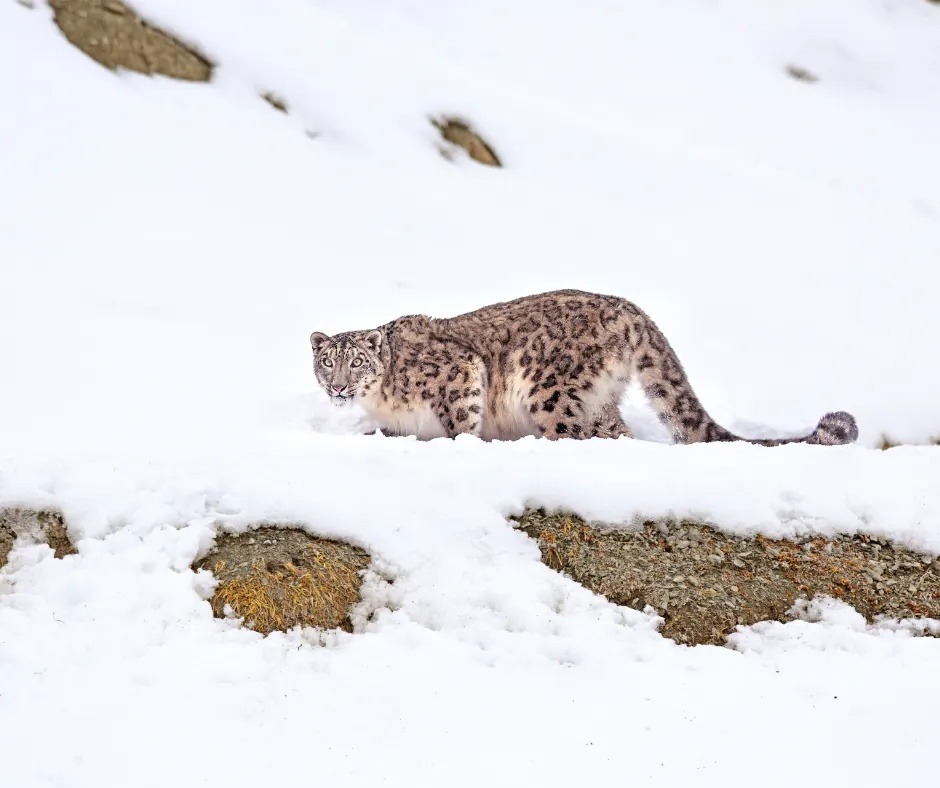
In both destinations, the mechanics are the same in principle. You are not walking through a forest hoping to nearly step on a snow leopard. You are set up on a vantage point, scanning valley faces with high-powered optics, reading the terrain systematically. The local spotters read the behaviour of blue sheep and ibex first. A herd grazing calmly in a loose scatter means nothing is nearby. A herd bunched tight on an impossible ledge, staring intently at one specific patch of slope - that is when the spotters freeze.
01 How Spiti Tracking Feels
The valley geometry around Kibber tends to give you more horizontal distance to work with. The snow leopard may be on the opposite face of a wide valley, half a kilometre to a kilometre away, visible against the snowfield for extended periods. When they are up and moving, you can sometimes track a cat for hours across open ground. The sightings can last a long time. The trade-off is that the terrain is demanding - long approaches at high altitude, extreme cold, and exposed ridgelines.
02 How Ladakh Tracking Feels
The gorge-cut terrain of Hemis introduces more variables. A cat can drop into a ravine and be invisible for forty minutes before reappearing. The sightings can feel more dynamic and unpredictable. The mating season peaks slightly earlier in Ladakh - pairs are sometimes observed together in early February, which is a rare and remarkable thing to witness. The acclimatisation window in Leh also means guests typically arrive at the high-country tracking zones in better physiological condition.
- Aly Rashid, Expedition Leader
What neither can promise: A sighting. Both destinations are honest places. The snow leopard is not performing. Some days, you will scan all morning and see nothing but a herd of bharal and a pair of golden eagles. Other days, within an hour of setup, a cat will materialise from the rock as if it had been painted there and only just decided to move. That uncertainty is the entire point. Read the full field mechanics in our Snow Leopard Ladakh guide and the Spiti Valley tracking guide.
Timing: Which Season Suits You?
01 Ladakh - February 1–10, 2027
Early February is deep winter in Ladakh. Leh daytime temperatures typically sit between -5°C and -1°C, while nights drop to -15°C or colder. At the tracking zones above Leh, temperatures are significantly harsher. The mating season for snow leopards runs from January through March, with February being the most active period in Hemis and Ulley - pairs are more frequently observed together, and males patrol territories with greater urgency, leaving fresh scent marks and scrapes. If witnessing territorial behaviour or a pair moving together is your priority, this departure catches that moment. The light is low and angled - beautiful for photography, but demanding.
02 Spiti - March 7–16, 2027
By mid-March, Spiti is still fully in winter's grip - do not let the date mislead you. Kibber at 4,270 metres sees daytime temperatures between 0°C and 5°C in direct sunshine, but nights plunge to -10°C and below, with wind chill making the felt temperature significantly colder. What changes from February is the light: the days are slightly longer, the sun a fraction higher, and the quality of light across those open snowfields becomes something photographers specifically seek out. Prey remains concentrated in the lower valleys before the spring melt begins pushing them upward, so tracking conditions remain excellent through mid-March.
Access and Logistics: Getting There
01 Reaching Ladakh
Leh has direct flights from Delhi, Mumbai, and several other major cities year-round, weather permitting. The flight into Leh is itself extraordinary - thirty minutes of Himalayan peaks before the runway appears at 3,500 metres. On arrival, a mandatory 48-hour rest in Leh is non-negotiable for acclimatisation before any altitude gain begins. Leh is a functioning town with solid medical infrastructure: the Sonam Norboo Memorial (SNM) Hospital is equipped with a hyperbaric oxygen chamber, dedicated oxygen generation plants, and a 24-hour emergency department. Portable oxygen cylinders are also available for rent from local pharmacies. It is a manageable starting point for anyone who has not been above 3,000 metres before.
02 Reaching Spiti
This is where the logistics diverge significantly. In winter, road access to Spiti is restricted. The Rohtang Pass route from Manali is closed; access is via the Shimla-Kinnaur Highway (Hindustan-Tibet Highway) through Reckong Peo. Plan for a full day of road travel from Shimla to Kaza, with the altitude gain happening rapidly over several hours of driving. A 4x4 vehicle is essential. There is no fly-in option for Spiti in winter. Kibber at 4,270 metres is the operational base; Kaza, the nearest town with limited services, sits at approximately 3,800 metres. Accommodation is primarily local homestays - functional and warm, but basic. Guests arriving for the Spiti departure should have prior high-altitude experience or follow the Just Nature acclimatisation schedule precisely.
Practical implication for first-timers: If this is your first expedition above 3,500 metres and altitude sickness is a genuine concern, Ladakh's access infrastructure and the acclimatisation buffer that Leh provides give you more margin. Spiti is an extraordinary environment, but you arrive at operational altitude more quickly, and the medical safety net is thinner. This is honest information for planning - not a disqualifier.
Which Is Right for You?
Choose Ladakh. Leh gives you a gentler acclimatisation curve, a warmer logistical base, the best medical infrastructure in the region, and more time to adjust before moving to tracking zones. The tracking experience is no less extraordinary for it.
Consider Spiti. The landscape around Kibber is uncompromised - no cultural texture to distract you, just mountain, snow, scope, and the ghost of the mountains. For wildlife trackers who find the purity of a totally barren environment more compelling than landscape variety, Spiti is the answer. Our full Spiti snow leopard tracking guide covers what to expect in detail.
Book Ladakh. The February 1–10 departure is positioned to intercept the period when snow leopards are most actively moving across territories, scent-marking, and occasionally observed in pairs. This window is specific to the Ladakh departure.
There is no wrong answer here. What I will tell you, from having tracked in both places across several seasons, is that I have never brought a guest to either destination and watched them leave disappointed. The ghost of the mountains does not distinguish between Kibber and Hemis.
Can You Do Both?
Some guests ask this, and it is a fair question. With departures in Ladakh (February 1–10) and Spiti (March 7–16) in the same season, a gap of approximately three to four weeks separates the two. Doing both is physically and logistically realistic for someone in good health who is prepared for two high-altitude stints.
You would leave Leh in mid-February, return to the plains to rest and recover at lower altitude for a few weeks, then head back up to Spiti in early March. It is demanding. The altitude acclimatisation process essentially repeats. But the reward is a first-hand understanding of two genuinely different tracking landscapes, two different light conditions, and two different expedition rhythms. Many serious wildlife enthusiasts who have done both describe them as complementary rather than redundant - the wide-open valley geometry of Spiti sitting very differently in memory from the gorge-cut drama of Hemis.
If this interests you, reach out to us directly and we will advise on the recovery window, logistics between departures, and whether your fitness profile suits a double expedition. View the Snow Leopard Ladakh expedition itinerary and the Snow Leopard Spiti expedition itinerary for full departure details.
Frequently Asked Questions
Is Spiti or Ladakh better for snow leopard tracking?
What is the best time to track snow leopards in Ladakh?
How difficult is high-altitude snow leopard tracking for a first-timer?
Can I see snow leopards in both Spiti and Ladakh on the same trip?
Which Indian operator runs snow leopard expeditions in both Spiti and Ladakh?
Both places are extraordinary. I do not say that to avoid committing - I say it because it is true, and because I have sat on enough cold ridgelines in both places to know that the experience of watching a snow leopard materialise from stone is not diminished by the latitude. What changes is the texture of the experience around it: the approach, the light, the terrain, and the particular quality of cold that settles into your bones.
The right question is not which is better. It is which is right for you, and that is a conversation worth having directly. Write to us, or message us on WhatsApp. Tell us about your fitness level, your altitude history, your calendar window, and what kind of landscape speaks to you. We will give you a straight answer.