Every October, when the forest gates across Madhya Pradesh swing open after the monsoon, my phone fills with variations of the same question. A guest planning their best tiger reserve India safari has narrowed the map to Central India's three most famous names and wants a straight verdict: Bandhavgarh vs Kanha vs Pench? Online portals answer that question by quoting census headcounts and airport drive times, as if choosing a forest were no different from comparing hotel star ratings. On the ground, these three reserves could hardly feel more distinct. In Bandhavgarh, you track beneath red Vindhya sandstone cliffs where territories overlap tightly. In Kanha, mist lifts off vast open maidans framed by towering sal trees. In Pench, dry teak leaves crackle underfoot while wild dog packs whistle along river backwaters. At Just Nature Expeditions, Erwin D'rose, Shivraj, and I have spent years working these tracks. Here is how they actually compare.
Table of Contents
- The Short Answer: How the Three Parks Actually Differ
- Park Topologies Compared: Three Very Different Forests
- Tiger Density, Territory, and How Tracking Works in Each Reserve
- Beyond the Tiger: Leopards, Dholes, and Signature Ecosystems
- For the Wildlife Photographer: Light, Backgrounds, and Vehicle Etiquette
- Safari Logistics: Access Gateways, Seasons, and Combining the Circuit
- Which Reserve is Right for You? Four Reader Profiles
- Where Satpura and Panna Fit Into This Picture
- Who Leads Our Central India Expeditions
- Frequently Asked Questions
The Short Answer: How the Three Parks Actually Differ
If you are trying to decide which reserve belongs on your itinerary, start by dropping the idea that one park is "the best" and the others are runners-up. All three sit within the same central Indian landscape belt managed under Project Tiger (National Tiger Conservation Authority), yet each has a completely different ecological personality.
Bandhavgarh The High-Density Stronghold
A compact core area tucked into the Vindhya hills. Steep rocky escarpments, bamboo valleys, and small marshy meadows pack resident tigers into close quarters. Sighting frequency is high, territorial drama is common, and vehicle traffic in prime zones requires a naturalist who knows how to stay ahead of the crowd.
Kanha The Ecological Benchmark
Vast, cathedral-like sal forests opening into sweeping grassy maidans in the Maikal hills. Home to the hard-ground barasingha. Because the core is expansive and visibility across the meadows is wide, Kanha is the finest reserve of the three for watching extended predator behaviour unfold without feeling hemmed in.
Pench The Teak & River Corridor
Undulating dry deciduous teak woodland straddling the Madhya Pradesh and Maharashtra border. Defined by open forest floors, rocky nalas, and the seasonal backwaters of the Pench River. Exceptional chital density supports not only tigers, but prolific packs of Indian wild dogs (dholes) and bold leopards.
| Comparison Factor | Bandhavgarh National Park | Kanha National Park | Pench Tiger Reserve |
|---|---|---|---|
| Primary Terrain & Flora | Vindhya sandstone cliffs, tabletop fort plateau, bamboo thickets, and mixed sal valleys | Maikal hills, towering sal forests, bamboo slopes, and vast open grassy maidans | Southern Satpura hills, undulating dry deciduous teak forest, open mahua clearings, and river backwaters |
| Tiger Territory Dynamics | Compact core geography with tight territorial overlap and frequent boundary encounters | Large core and buffer system; wide patrol routes across meadows and fire lines | Healthy, well-distributed population moving between riverine pools and teak ridges |
| Typical Sighting Character | Close-range encounters along bamboo tracks, waterholes, and rocky valley roads | Longer, atmospheric observations across open meadows and misty forest corridors | Acoustic tracking following chital and langur alarm calls through open-canopy teak |
| Co-Predators & Key Species | Leopard, sloth bear, sambar, barking deer, cliff-nesting vultures and eagles | Hard-ground barasingha, Indian gaur, wild dog (dhole), sloth bear, leopard | Prolific Indian wild dog (dhole) packs, leopard, Indian gaur, chital herds, jackal, 300+ bird species |
| Crowd & Jeep Pressure | High in core zones (Tala, Magadhi, Khitauli); demands predictive positioning | Moderate; larger spatial spread absorbs vehicles better away from main meadow hubs | Moderate on main tracks; feels noticeably more open when working secondary teak lines |
| Primary Entry Gateways | Jabalpur or Khajuraho (road connection) | Jabalpur, Raipur, or Nagpur (road connection) | Nagpur or Jabalpur (closest major airport access from Nagpur) |
Park Topologies Compared: Three Very Different Forests
To someone looking at a satellite map of Madhya Pradesh, all three reserves appear as green patches separated by a few hundred kilometres of farmland and scrub. Once you climb into an open four-wheel-drive vehicle at dawn, however, the physical geometry of the land changes everything: how far your eye can travel, how sound carries across a valley, and how a two-hundred-kilogram cat uses cover.
01 Bandhavgarh: Sandstone Fortresses and Bamboo Valleys
Bandhavgarh is a vertical landscape. Rising out of the heart of the reserve is the ancient Bandhavgarh Fort plateau, a sheer sandstone massif flanked by thirty-two smaller hills. Between these steep escarpments lie narrow valleys choked with giant bamboo (Dendrocalamus strictus), mixed sal forest, and small, spring-fed marshy meadows such as Chakradhara and Rajbehra.
Because the hills hem the valleys in, movement in Bandhavgarh is channelled. A tiger moving from one valley to the next cannot simply walk in any direction; it uses specific passes, rocky saddles, and sandy fire lines. That natural funnelling is why Bandhavgarh feels so intimate and dramatic. You are rarely scanning a horizon two kilometres away. More often, you are listening to a sambar bell echoing off a rock wall two hundred metres above the track, waiting for a cat to step out of dense bamboo twenty yards from your front bumper.
02 Kanha: Cathedral Sal Forests and the Great Maidans
Step into Kanha and the horizon opens up. Situated in the Maikal range of the eastern Satpuras, Kanha is built on a grander scale. Its signature feature is the contrast between two habitats: deep, straight-trunked sal (Shorea robusta) forests that hold the morning chill well into the day, and vast, rolling grasslands known locally as maidans.
Many of these maidans, including Kanha, Kisli, and Mukki meadows, are historic village sites where forest communities were relocated decades ago and the land returned to native grass. Today, those open expanses support thousands of spotted deer, sambar, Indian gaur, and the park's flagship species, the endangered hard-ground barasingha (swamp deer). Unlike Bandhavgarh's tight valleys, Kanha gives you sightlines across hundreds of metres of waving golden grass, ringed by misty flat-topped plateaus called dadars.
03 Pench: Undulating Teak and the River Backwaters
Drive southwest from Kanha toward the Maharashtra border and the evergreen sal gives way to dry deciduous teak (Tectona grandis). Pench is the landscape that inspired the setting of Rudyard Kipling's The Jungle Book, complete with the Wainganga River gorge country nearby.
In Pench, the terrain rolls in gentle waves rather than sharp cliffs. Teak leaves are broad and dry; by late winter they drop to the ground in a crisp carpet that turns the understory open and bright, dotted with white-barked kulu (ghost) trees, mahua groves, and rocky dry stream beds (nalas). Cutting right through the reserve is the Pench River and the Totladoh reservoir backwaters. As the dry season progresses from March into May, the receding water leaves behind emerald grass fringes and isolated pools that act as a magnet for every herbivore and predator in the forest.
Tiger Density, Territory, and How Tracking Works in Each Reserve
As we explain in our Tigers Unlimited: Top Tiger Reserves hub, no honest naturalist will ever promise you a guaranteed tiger sighting. Wild forests do not run on schedules. What differs across Bandhavgarh, Kanha, and Pench is the mechanics of how a naturalist tracks a tiger, and how the encounter unfolds when you find one.
Tracking in Bandhavgarh: Anticipating the Next Move
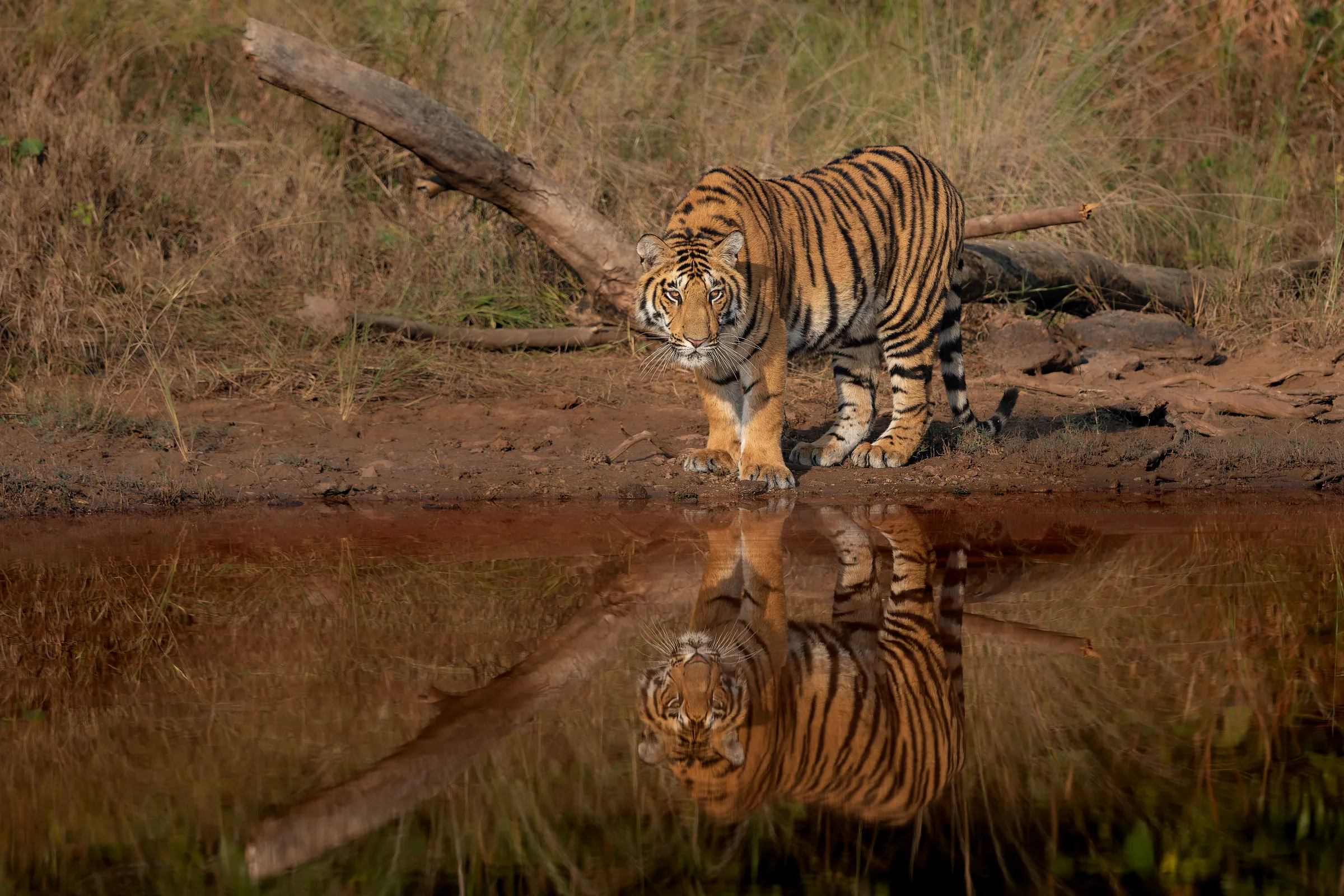
Bandhavgarh has long held one of the highest densities of Royal Bengal Tigers in India relative to the size of its core tourism zones (primarily Tala, Magadhi, and Khitauli). Because so many adult males, breeding females, and dispersing sub-adults share a compact landscape, territories are smaller and contested fiercely. Tigers here patrol road networks constantly to refresh scent marks and scrape trees.
The field reality of Bandhavgarh, however, is that high tiger density attracts high vehicle density. When a bold tigress lies down beside a main track in Magadhi or Tala, fifteen jeeps can converge within minutes. If you are travelling with a standard driver whose only instinct is to join the queue of idling engines, the magic evaporates quickly.
When we lead guests in Bandhavgarh, our job is predictive positioning. Because we study the direction of the morning pugmarks, the angle of the ravine, and the heat of the sun, we do not sit in the middle of a twenty-jeep traffic jam. We ask a different question: When this tigress stands up to move into shade in twenty minutes, which fire line or waterhole must she cross? Positioning your vehicle quietly at that exit point gives you ten unhurried minutes with the cat walking straight toward you before a single other vehicle catches up.
Tracking in Kanha: Reading Erwin's Five-Year Map
In Kanha, the tracking game is deeper and more expansive. Before joining Just Nature Expeditions, our Senior Naturalist Erwin D'rose spent five consecutive years stationed at Kanha studying tiger behaviour, followed by over eight years at Reni Pani in Satpura. Five years in one reserve means you stop seeing the forest as a collection of numbered roads and start seeing it as a living social map.
- Erwin D'rose, Senior Naturalist & Expedition Leader
Because Kanha's core zones (Kanha, Kisli, Mukki, and Sarhi) cover a much broader footprint than Bandhavgarh, tigers hold larger territories and have more room to move unseen through dense sal underbrush. Tracking here begins at dawn by checking the soft dust along the quiet fire lines for overnight pad marks, distinguishing the broad, square-toed print of a territorial male from the narrower pad of a tigress. When a herd of barasingha or chital freezes in the middle of a misty meadow, all necks craned toward a specific bamboo edge, Erwin knows whether the cat is cutting across the grass or using a hidden drainage ditch (nala) to flank the herd. Sightings in Kanha often last longer and feel calmer because the open meadow geometry gives both the animal and the observer breathing room.
Tracking in Pench: Acoustic Triangulation in Open Teak
Pench is an acoustic tracker's paradise. Because the undulating teak forest and river meadows support an extraordinarily high density of prey (particularly spotted deer and Hanuman langurs), a predator can rarely take ten steps in daylight without setting off a chain reaction of warning calls.
In Pench's Turia, Karmajhiri, and Wolf Sanctuary buffer zones, visibility through the leafless winter and spring teak trunks is cleaner than in Kanha's dense sal. Our naturalists work Pench largely with their ears, engine switched off at key intersections. You listen for the sharp, high-pitched bark of a chital doe, followed by the guttural cough of a langur high in a mahua tree, and trace the line of sound as the tiger threads its way along a dry rocky stream bed toward the Pench River backwaters.
Beyond the Tiger: Leopards, Dholes, and Signature Ecosystems
A traveller who judges a Central Indian safari solely by the minutes spent looking at a tiger misses eighty percent of what makes these forests extraordinary. As we detail in our Big Cats of India: A Naturalist's Complete Guide, the Royal Bengal Tiger shares its forest with a remarkable guild of co-predators, ungulates, and birds, and the balance shifts from park to park.
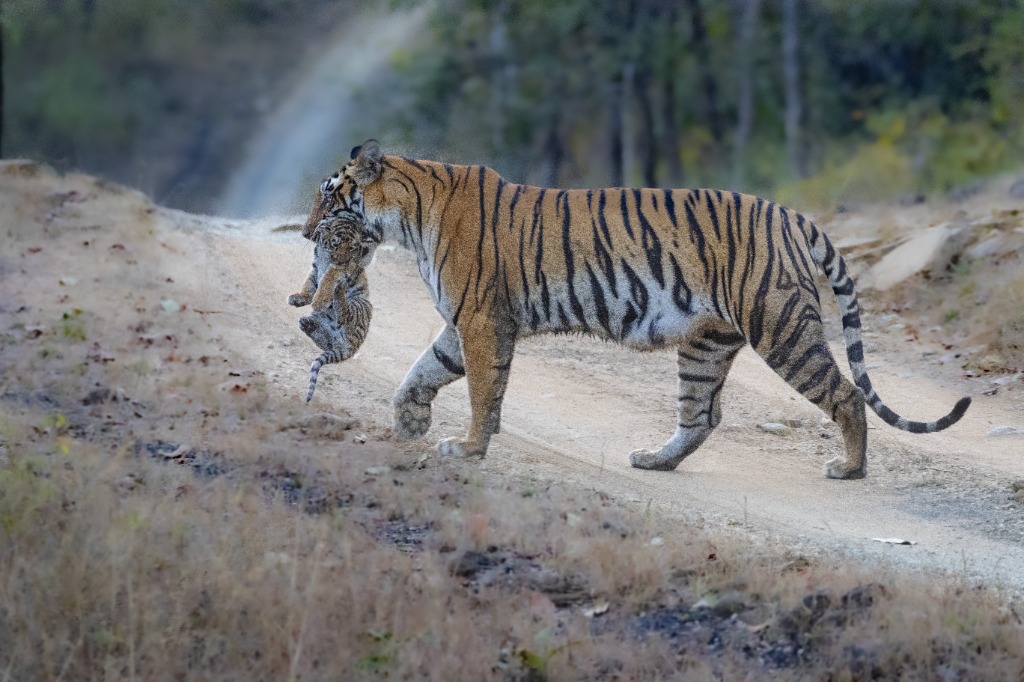
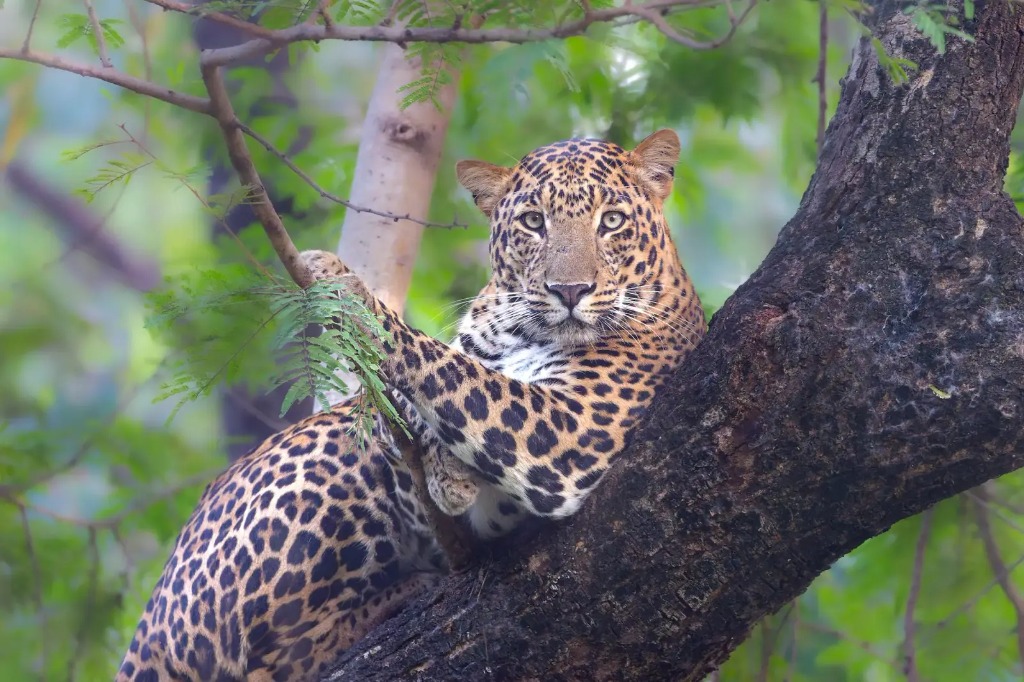
- Indian Leopards (Panthera pardus fusca): Because tigers dominate the valley floors in Bandhavgarh and Kanha, leopards there are pushed toward rocky ridges and buffer edges. Pench, by contrast, is one of the finest tiger reserves in Central India for leopard sightings; its rocky outcrops, kulu trees, and active buffer zones allow leopards to thrive in high numbers.
- Indian Wild Dogs / Dholes (Cuon alpinus): Watching a pack of dholes communicate with soft, bird-like whistles before coordinating a high-speed relay hunt through the forest is every bit as gripping as a tiger sighting. Both Kanha and Pench are premier strongholds for wild dogs, with Pench's open teak corridors offering exceptionally clear views of pack interactions.
- The Hard-Ground Barasingha (Rucervus duvaucelii branderi): Found in the wild nowhere else on earth except Kanha (and a small reintroduced population in Satpura and Bandhavgarh), this subspecies of swamp deer was rescued from fewer than seventy individuals in the 1960s through dedicated meadow management. Watching a stag drape wet grass across its twelve-tined antlers in the Kanha mist is an iconic Indian wildlife moment.
- Indian Gaur & Sloth Bears: Massive herds of Indian gaur (the world's largest wild cattle) graze across both Kanha and Pench, migrating between the two via forest corridors. For sloth bears (Melursus ursinus), Bandhavgarh's rocky caves and mahua-rich valleys offer frequent early-morning encounters.
- Avian Diversity: All three parks hold close to three hundred bird species. Bandhavgarh's sandstone cliffs host nesting long-billed vultures, shaheen falcons, and Malabar pied hornbills; Kanha's shaded streams and bamboo hold crimson sunbirds, racket-tailed drongos, and crested serpent eagles; Pench's reservoir backwaters attract winter congregations of migratory waterfowl, ospreys, and grey-headed fish eagles.
For the Wildlife Photographer: Light, Backgrounds, and Vehicle Etiquette
Our naturalist and wildlife photographer Shivraj has spent more than twelve years photographing predators across Central India. When photographers ask him to compare Bandhavgarh, Kanha, and Pench, he does not start with tiger counts. He talks about light quality, background separation, and vehicle angles.
1. How Light and Backgrounds Differ
In Kanha, winter mornings (November through February) produce a low, luminous ground mist over the maidans as the first sunbeams slant through the sal canopy. If a tiger or a herd of barasingha steps into that golden grass, the subject separation with a 400mm or 600mm lens is unmatched anywhere in India. Inside the deep sal forest, however, the canopy is tall and dark, requiring fast apertures and strong high-ISO performance until mid-morning.
In Bandhavgarh, the photographic signature is texture and intimacy. Ancient moss-covered stone ruins, dark green bamboo culms, and rust-red sandstone cliffs frame the cats closely. Because sightings often happen at shorter distances along narrow valley tracks, a versatile zoom lens (such as a 100-400mm or 100-500mm) alongside a long prime is indispensable so you do not clip a tiger's frame when it walks past your wheel.
In Pench, the dry deciduous teak canopy lets light reach the forest floor earlier in the morning and holds a warm, amber glow late into the afternoon. The pale trunks of ghost trees and the dark basalt boulders along the riverbeds create stark, high-contrast environmental portraits, especially when photographing a pack of dholes on the move.
2. Why Vehicle Etiquette Makes or Breaks Your Portfolio
Anyone who has joined a generic shared jeep safari knows the frustration of seeing a tiger in beautiful light, only to have the driver park nose-to-tail behind four other vehicles, leaving you shooting through a wall of spare tyres and fluorescent tourist jackets. Or worse, having five people in the same jeep standing up and rocking the suspension every time you press the shutter.
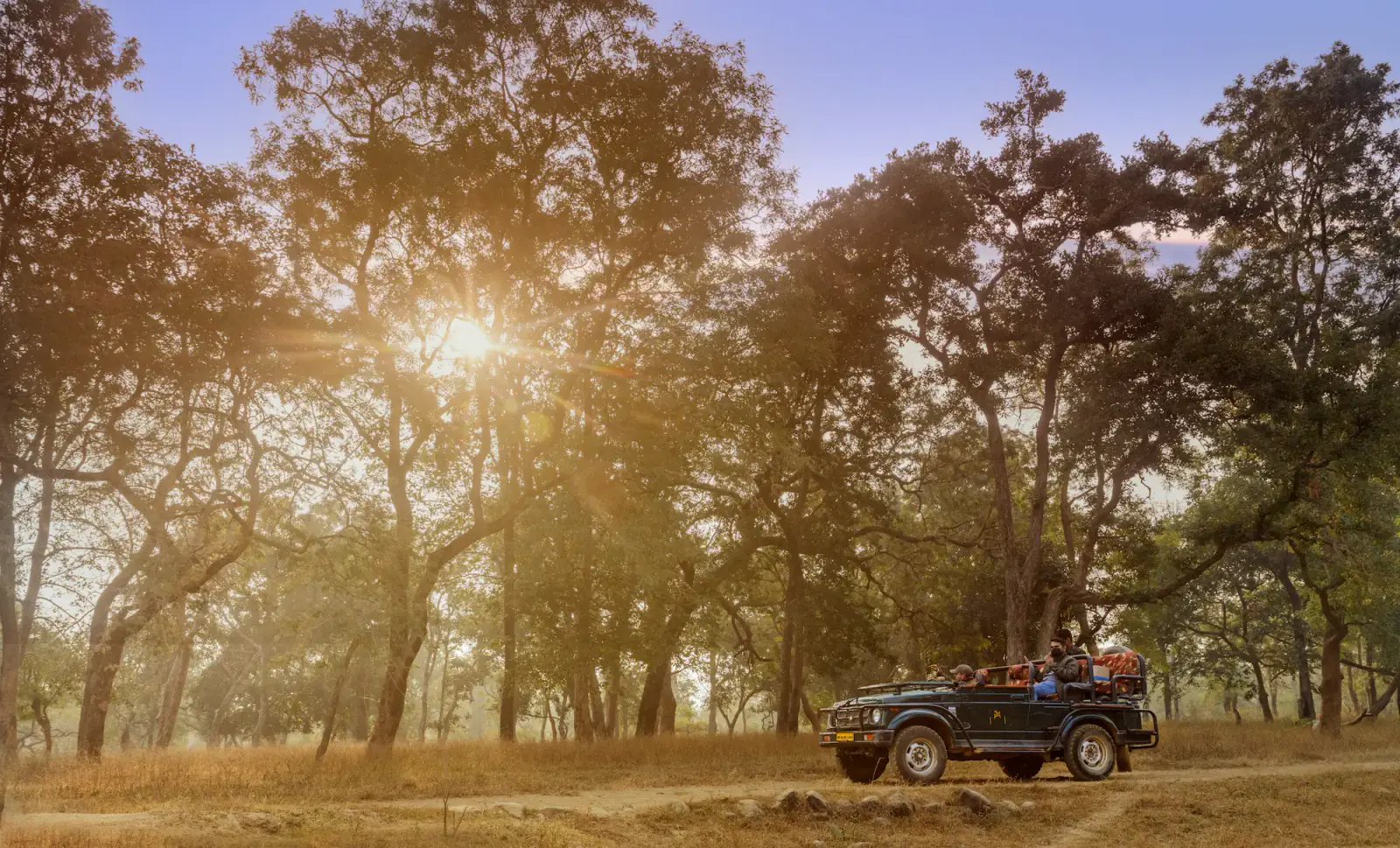
On Just Nature Expeditions, we keep vehicle occupancy low so every guest has unobstructed shooting space and stable beanbag support. Just as importantly, Shivraj, Erwin, and I communicate directly with the forest driver to position the vehicle for eye-level angles and clean backgrounds, whether that means waiting fifty metres back so a tiger walks toward your lens in open light, or cutting the engine early so the cat remains relaxed. If you are travelling without a heavy super-telephoto setup, you can also reserve professional bodies and telephoto lenses directly through our in-house Camera Rentals programme prior to your departure.
Safari Logistics: Access Gateways, Seasons, and Combining the Circuit
One of the greatest practical advantages of Madhya Pradesh's eastern wildlife belt is how cleanly the geography connects once you are on the ground. You can explore our Central Indian Jungles destination guide for a broader look at the region, or use the framework below to plan your routing.
Airport Gateways and Overland Connections
Three regional airports anchor the Bandhavgarh-Kanha-Pench triangle, all with daily connections from Delhi, Mumbai, or Hyderabad:
- Nagpur (Maharashtra): The primary southern gateway and the most convenient entry point for Pench Tiger Reserve via a well-maintained highway transfer, and a common onward gateway to southern Kanha.
- Jabalpur (Madhya Pradesh): The central hub sitting roughly equidistant between Bandhavgarh (to the northeast), Kanha (to the southeast), and Pench (to the south). Ideal for circular two-park itineraries.
- Raipur (Chhattisgarh) & Khajuraho (Madhya Pradesh): Raipur serves as a smooth eastern exit or entry point for Kanha (especially the Mukki side), while Khajuraho connects northern circuits through Panna and down into Bandhavgarh, the exact route we use on our Tigers Unlimited fixed-departure expedition.
Seasonality: October Reopening Through the Summer Waterhole Window
Core tourism zones across Bandhavgarh, Kanha, and Pench close during the heavy monsoon rains (July through September) and reopen in October. Note that Madhya Pradesh tiger reserves also observe weekly afternoon closures (traditionally Wednesday afternoons) and specific national holiday closures, which we factor into every itinerary calendar so you never lose a scheduled drive:
- October to January (Lush Canopies & Winter Mist): The post-monsoon forest is vibrant green, streams are full, and winter mornings bring dramatic mist over Kanha's meadows and frost to open clearings. Dawn jeep rides are genuinely cold (pack thermal layers and windproof jackets), and tracking relies heavily on alarm calls and fresh road pugmarks.
- February to March (The Naturalist's Sweet Spot): This is why we scheduled our flagship Tigers Unlimited departure for February 15-26, 2027. The biting mid-winter chill eases, the deciduous understory begins to thin and dry out, sightlines open up across the forest floor, migratory and resident birdlife is in full display, and big cat movement remains active throughout the morning and late afternoon.
- April to June (High Heat & Waterhole Concentration): Daytime temperatures climb sharply, and the forest turns dry and copper-gold. For hardened wildlife enthusiasts and photographers who do not mind the heat, sightings become highly concentrated as tigers, leopards, and dholes tether themselves to the remaining shaded waterholes and river pools.
Which Reserve is Right for You? Four Reader Profiles
When a guest calls us to plan a trip, we ask how many days they can spend away from home, how many safaris they have done before, and what they hope to feel when they are out in the forest. Here is our honest decision framework:
If you have limited days, want the highest statistical probability of crossing paths with a Royal Bengal Tiger, and love the visual drama of sandstone cliffs and ancient fort ruins, Bandhavgarh is the strongest single-park choice. Just be sure you travel with a dedicated naturalist who knows how to work around the core-zone vehicle crowds.
If you want to experience the grandest landscape in Madhya Pradesh, watch hard-ground barasingha in the morning mist, and observe tigers patrolling across wide open maidans rather than darting across narrow tracks, choose Kanha. Having Erwin D'rose guide you through a forest he studied daily for five years turns Kanha into a masterclass in field ecology.
If watching a pack of fifteen Indian wild dogs whistle and hunt through open teak woodland or photographing a leopard draped over a ghost-tree branch excites you as much as tracking a tiger, Pench is deeply rewarding. Its proximity to Nagpur also makes it the cleanest choice for shorter four-to-five-day wilderness breaks.
You do not have to choose just one. Because Kanha sits roughly halfway between Pench and Bandhavgarh, pairing Pench + Kanha or Bandhavgarh + Kanha (or joining our 12-day Panna + Bandhavgarh + Kanha Tigers Unlimited expedition) lets you experience how the same apex predator adapts to radically different terrains on a single overland journey.
Where Satpura and Panna Fit Into This Picture
Before you lock in your itinerary, allow me to add one perspective as a naturalist who has spent his life in Madhya Pradesh. Most travellers ask solely about Bandhavgarh, Kanha, and Pench because those are the three names every travel agency markets. Yet two of Central India's finest wildernesses sit right alongside them, offering modes of exploration that are strictly prohibited in the classic three:
Satpura Tiger Reserve is my personal home forest, where I spent over seven years heading the naturalist team at Reni Pani Jungle Lodge and writing Tales from the Bush. Satpura is the only tiger reserve in Central India where we can take you out of the jeep and onto the forest floor on foot, tracking tigers, leopards, and sloth bears at eye level, as well as paddling silently along the Denwa River backwaters. You can explore how we run this in our Satpura Explorer expedition, or read our ecological field guide to Satpura's Super Six: A Naturalist's Deep Dive.
Panna National Park, north of Bandhavgarh near Khajuraho, is where I worked on the 2014 Caracal Research and Conservation Project with Dr. Shekhar Kolipaka. Carved by the deep gorges of the Ken River, Panna pairs thriving reintroduced tiger territories with boat safaris past gharials and cliffs where seven vulture species nest. That is why our flagship Tigers Unlimited itinerary links Panna, Bandhavgarh, and Kanha into one twelve-day arc, and why our bespoke Luxury Wildlife Holiday in India journeys frequently blend Kanha or Pench with Satpura or Panna. See our dedicated Panna Expedition page for full habitat details.
Who Leads Our Central India Expeditions
As we emphasise in our guide on how to choose a wildlife expedition operator in India, the single biggest variable on a tiger safari is not which hotel you book, or even whether you choose Kanha over Bandhavgarh. It is who sits in the vehicle with you.
When you travel with Just Nature Expeditions, whether on a small-group fixed departure in our Guided Tours collection or a private journey from our Tailor-Made Safaris portfolio, you are accompanied by our core Bhopal-based naturalist team:
- Erwin D'rose (Senior Naturalist & Expedition Leader): Born in Jabalpur at the crossroads of Madhya Pradesh's tiger reserves, Erwin spent five years in Kanha National Park studying tiger behaviour and territorial movement before spending eight years as a senior naturalist and lodge manager in Satpura.
- Aly Rashid (Founder & Naturalist Expedition Leader): Trained naturalist and ornithologist, 7+ years heading the naturalist team at Reni Pani Jungle Lodge, caracal researcher in Panna National Park (2014), and author of Tales from the Bush: A Peek into the World of Satpura.
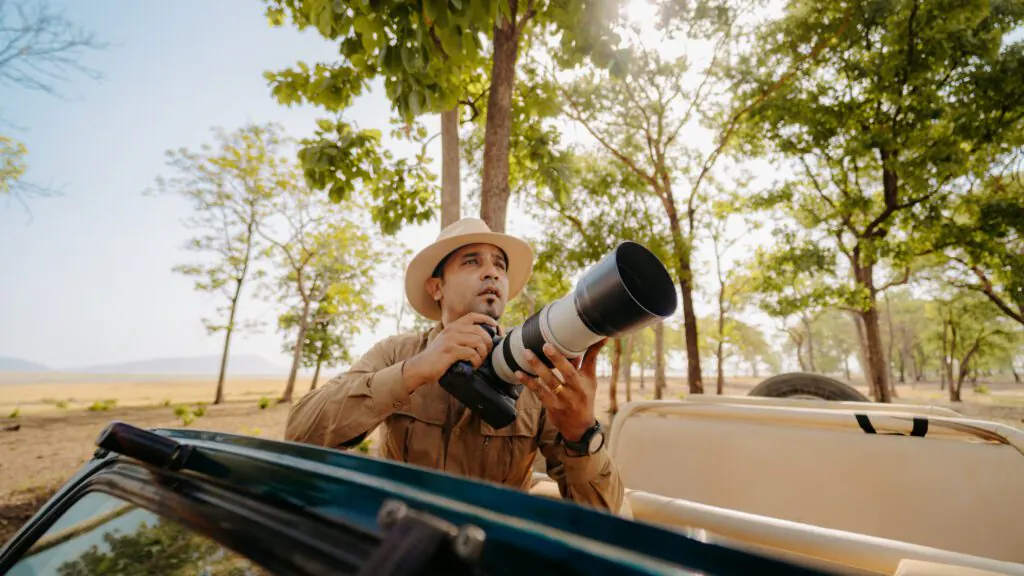
- Shivraj (Naturalist & Wildlife Photographer): Over twelve years of field experience trained alongside African safari guides across Kanha, Panna, Bandhavgarh, and Satpura, specialising in big cat tracking and in-field photography mentorship.
Read the full credentials of our team on the Expedition Leaders page, or browse all of our Indian and international habitats on our Destinations hub.
Frequently Asked Questions
Which is better for a tiger safari: Bandhavgarh, Kanha, or Pench?
Which national park has the highest tiger sighting probability among Bandhavgarh, Kanha, and Pench?
Is Kanha or Bandhavgarh better for wildlife photography?
Can you combine Kanha, Bandhavgarh, and Pench in one itinerary?
What is the best month to visit Bandhavgarh, Kanha, and Pench?
Why book a naturalist-led expedition instead of a standard zone safari in Madhya Pradesh?
Choose Your Forest - Or Track Across All Three
There is no wrong choice among Bandhavgarh, Kanha, and Pench, only the frustration of picking a reserve whose rhythm does not match what you hoped to experience, or visiting it without a naturalist who knows how to read its tracks.
You have two ways to step into Central India with us this season:
- Join our Fixed-Departure Group Expedition: Our 12-day Tigers Unlimited expedition (February 15-26, 2027), led by Erwin D'rose and Aly Rashid, takes a small group of eight guests across Panna, Bandhavgarh, and Kanha in the prime late-winter tracking window.
- Design a 100% Tailor-Made Private Safari: Whether you want a focused single-park photography stint in Kanha or Bandhavgarh, a connected Pench + Kanha wildlife circuit, or a bespoke Luxury Wildlife Holiday in India or Big Cats of India expedition, we build private itineraries around your exact dates, pace, and preferred wilderness lodges.