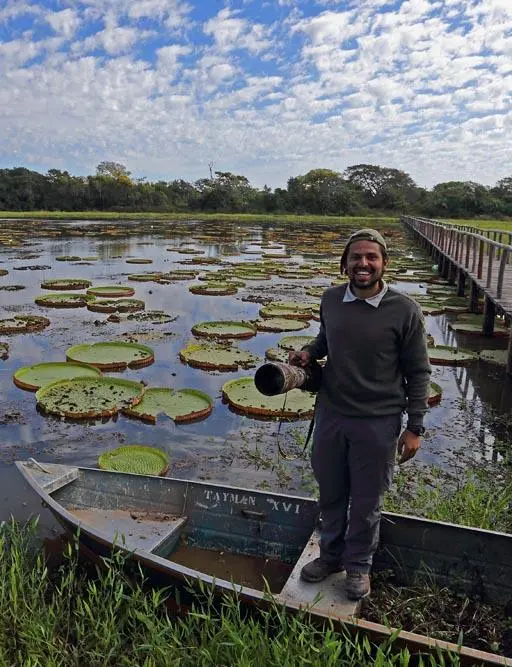
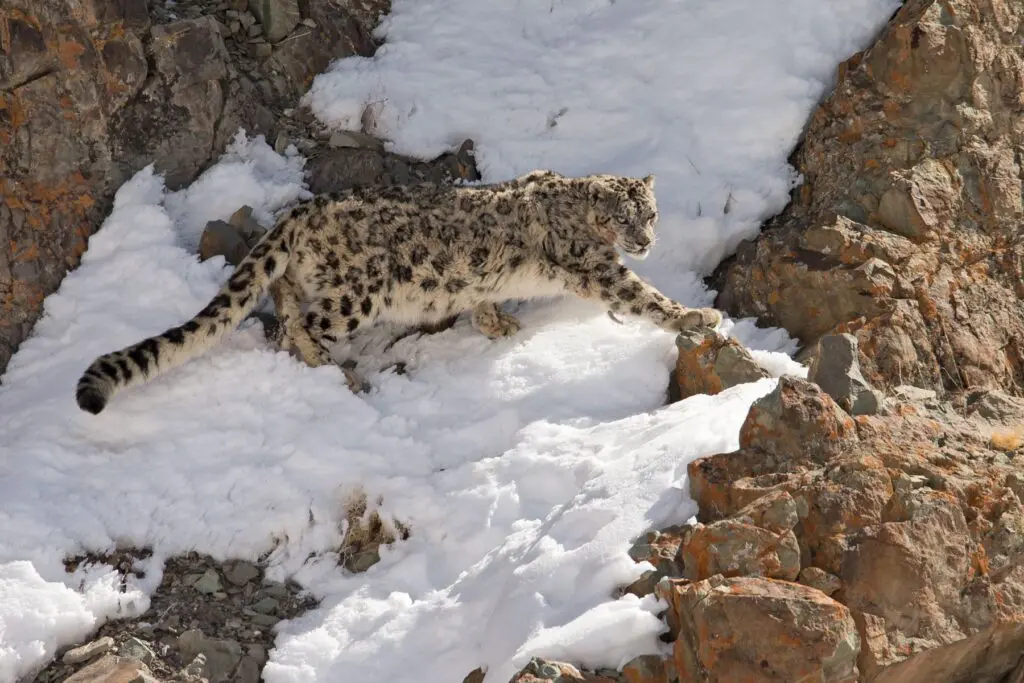
At 3,900 metres in Ladakh's Rumbak Valley, you learn very quickly that a snow leopard tour is won with your eyes long before it is won with your legs. The thermometer outside our homestay reads minus eighteen degrees Celsius at dawn. Across the Zingchen Gorge, the alarm call of a blue sheep echoes off vertical slate cliffs. When I lead guests here for Just Nature Expeditions, we do not rush down forest tracks the way we do in Central India. Instead, our local Ladakhi spotters lock their Swarovski spotting scopes onto a jagged ridgeline and dissect the mountainside square metre by square metre until the stones themselves seem to breathe.
Many travellers assume Ladakh is only accessible during the warm summer months when the high mountain passes open to road trips. For general sightseeing, that holds true. For tracking Panthera uncia, locally revered across Ladakh as Shan, the exact opposite applies. The best snow leopard tour in Ladakh takes place in the dead of winter between January and March, when heavy snowpack seals the 5,000-metre alpine pastures and funnels both prey and predator down into the lower river gorges around Leh.
Whether you are comparing Hemis National Park with the vehicle-accessible ridgelines of Ulley, evaluating 10-day expedition costs, or preparing for high-altitude cold, this updated field guide breaks down everything you need to plan an ethical, naturalist-led journey into the Trans-Himalayas.
Table of Contents
- 1. What Makes Ladakh the Best Snow Leopard Tour Destination?
- 2. When Is the Best Time for a Snow Leopard Tour in Ladakh?
- 3. Where Do You Track Snow Leopards: Rumbak (Hemis) vs Ulley?
- 4. What Other Rare Himalayan Wildlife Will You See in Ladakh?
- 5. How Does a 10-Day Ladakh Snow Leopard Expedition Work?
- 6. How Much Does a Snow Leopard Tour in Ladakh Cost?
- 7. How Do You Prepare for Altitude and Sub-Zero Cold?
- 8. Frequently Asked Questions
What Makes Ladakh the Best Snow Leopard Tour Destination in the World?
To understand why serious wildlife enthusiasts fly into Kushok Bakula Rimpochee Airport in Leh every winter, you have to look at the geography of the Trans-Himalayas. Situated in the rain shadow north of the main Himalayan crest, Ladakh's high-altitude wilderness sits at elevations starting around 3,500 metres (11,500 feet) in the Indus Valley and rising past 6,000 metres on the surrounding peaks.
Because monsoon clouds rarely cross the Zanskar and Great Himalayan ranges, Ladakh is a stark, treeless cold desert. For a wildlife tracker, this absence of forest canopy changes everything. In Central India, a tiger can vanish into dense sal or bamboo cover three metres from your jeep. In Ladakh, the open scree slopes and deeply carved shale gorges allow our spotters to scan three to four kilometres of cliff face from a single vantage point.
According to the IUCN Red List assessment for Panthera uncia and field surveys under the Wildlife Institute of India's Snow Leopard Population Assessment in India (SPAI), Ladakh holds roughly 477 snow leopards, representing nearly 68% of India's entire confirmed population of 718 individuals. Inside Hemis National Park alone, camera-trap studies conducted with the Snow Leopard Trust have recorded densities of 4 to 6 cats per 100 square kilometres in prime winter valleys.
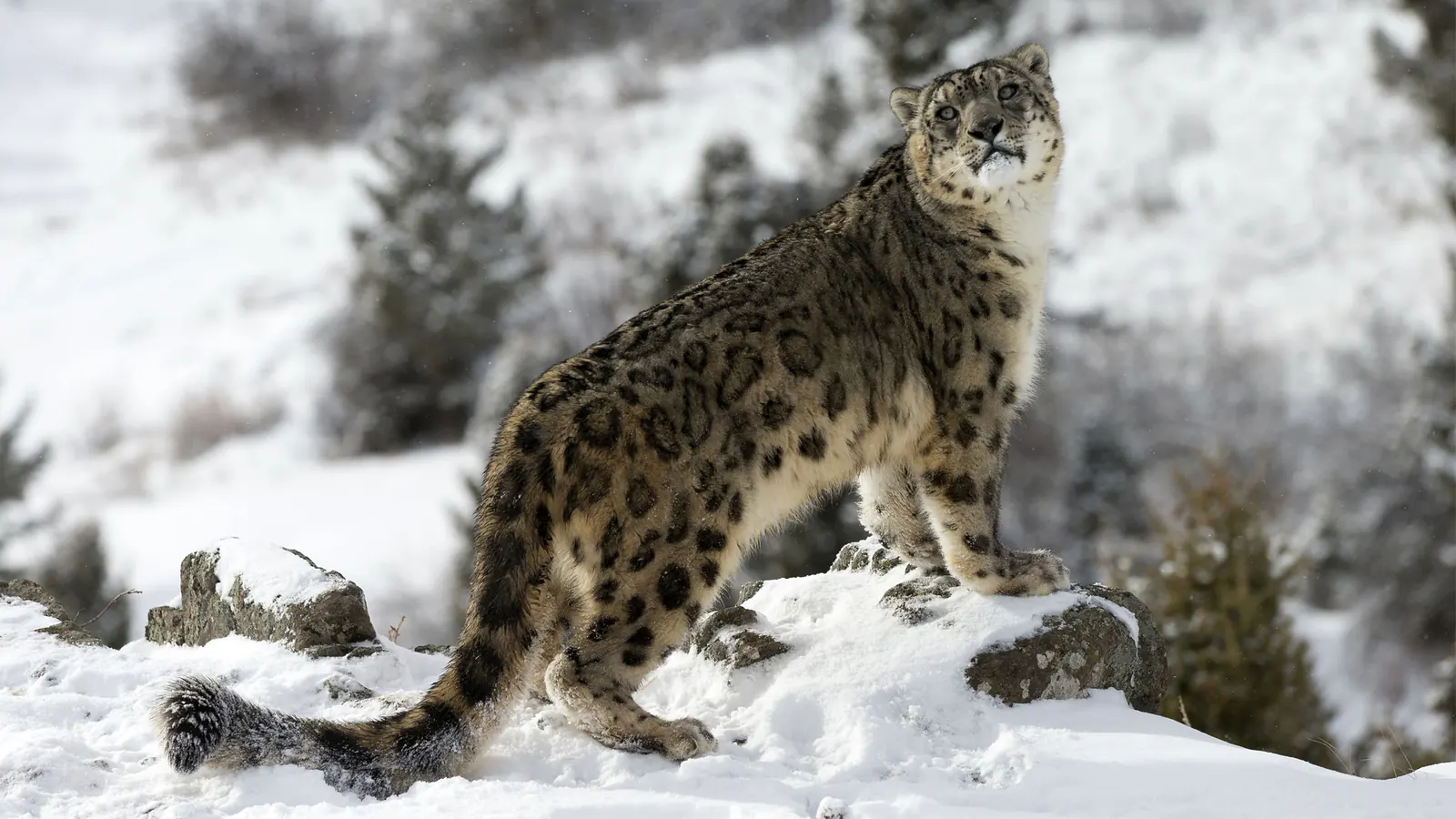
When Is the Best Time for a Snow Leopard Tour in Ladakh?
One of the most common misconceptions in general travel guides is that visitors should avoid Ladakh during the harsh winter months. If your goal is riding a motorcycle over Khardung La or camping beside Pangong Lake, summer (June to September) is indeed your window. But if you visit Ladakh in July hoping to see a snow leopard, you will be staring at empty lower ridges while the cats hunt above 5,200 metres near the permanent snowline.
In winter, the ecological equation flips. By late December and January, heavy snowfall buries the high alpine meadows. Herds of bharal (blue sheep) and Asiatic ibex descend into the lower valleys like Rumbak, Husing, Tarbung, and Ulley, where steep, wind-scoured slopes expose sparse tufts of dry sedge and Caragana scrub.
The snow leopards follow their larder down the mountain. Furthermore, late January through March marks the annual mating season. Normally solitary cats begin patrolling overlapping ridgelines, refreshing scent scrapes at the base of overhanging boulders, and calling across the gorges at dusk. That is why we schedule our flagship Snow Leopard Ladakh 2027 fixed-departure expedition from 1st to 10th February 2027.
| Month / Window | Valley Temps (Day / Night) | Snow Leopard Behaviour & Elevation | Sighting Probability | Ideal Traveller Profile |
|---|---|---|---|---|
| November – December | 0°C to -5°C / -10°C to -15°C | Early winter descent; cats begin following blue sheep down from 4,500m+ ridges; clearer skies and lighter snowpack. | Moderate–High (60%–70%) | Photographers wanting dramatic autumn-to-winter rock contrast and milder cold. |
| January | -3°C to -8°C / -15°C to -22°C | Deep winter freeze locks high passes; prey concentrates heavily in Rumbak, Zingchen, and Ulley gorges (3,600m–4,000m). | High (75%–80%) | Serious wildlife trackers seeking pristine snowscapes and quiet trails. |
| February (Peak Window) | -2°C to -6°C / -14°C to -25°C | Peak mating season; males and females travel together, vocalise, and scent-mark frequently on lower valley ridgelines. | Very High (80%–85%+) | First-time snow leopard guests and photographers prioritising behavioural interactions. |
| March | +2°C to -3°C / -10°C to -18°C | Late winter snowstorms mix with longer daylight hours; cats remain in lower valleys before gradual spring ascent. | High (75%–85%) | Guests wanting longer daily photography windows and slightly warmer afternoons. |
| May – October (Summer) | +15°C to +25°C / +2°C to +10°C | Prey migrates above 4,800m–5,500m; snow leopards disperse across vast high-altitude peaks. | Low (<15%) | Best for Himalayan brown bear in Dras, birding, Black-necked Cranes, and cultural tours. |
Where Do You Track Snow Leopards in Ladakh: Rumbak (Hemis) vs Ulley Valley?
When comparing operators for a Ladakh expedition, the first question you should ask is where you will actually spend your field hours. If you have read our Spiti vs Ladakh snow leopard comparison, you know that Ladakh's edge lies in the diversity of its valleys. Rather than confining you to a single canyon, a well-designed Ladakh tour leverages both the east-bank stronghold of Hemis National Park and the west-bank valleys around Ulley and Gya-Lato.
01 Why Is Rumbak Valley in Hemis National Park the Classic Tracking Hub?
Founded in 1981 and named after the 400-year-old Hemis Monastery, Hemis National Park is the largest contiguous protected area in South Asia at 4,400 square kilometres. Once we drive past Phey Bridge along the Indus River and enter the narrow rock walls of the Zingchen Gorge, the road gives way to core snow leopard territory.
Staying in traditional village homestays or winter base camps in Rumbak places you directly beneath the ridgelines where snow leopards patrol at dawn. Because Rumbak sits at the junction of several steep side nullahs (including Husing junction, where three valleys meet), spotters can position scopes on a central knoll and monitor multiple cliff faces simultaneously. It is common here to watch a cat rest on a sunlit overhang for four hours before descending at dusk to stalk blue sheep.
02 How Does Ulley Valley Offer Vehicle-Accessible Snow Leopard Tracking?
While Rumbak requires walking between scanning points, the Ulley and Saspochey valleys north of Uleytokpo feature a winding mountain road that climbs directly through prime habitat. For photographers working with 600mm f/4 lenses and heavy gimbal heads, or guests who prefer less trekking at altitude, Ulley is a revelation.
Our spotters fan out early in the morning along the Ulley river gorge, communicating via walkie-talkie. When a fresh pugmark trail, kill site, or resting cat is located, our group can drive within walking distance of the vantage point. Ulley is also one of the finest places in Ladakh to photograph Asiatic ibex, whose males carry sweeping scimitar horns over a metre long, alongside Eurasian lynx and packs of Tibetan wolves.
| Feature | Rumbak Valley (Hemis National Park) | Ulley Valley (West Leh Corridor) | Gya-Lato & Indus Valley |
|---|---|---|---|
| Average Altitude | 3,800m – 4,100m (12,460 – 13,450 ft) | 3,650m – 4,050m (11,975 – 13,280 ft) | 3,400m – 3,700m (11,150 – 12,140 ft) |
| Tracking Style | Gentle gorge treks + stationary scope scanning from Husing & Rumbak ridges | 4x4 vehicle-assisted ridge scanning + short walks to vantage points | Full-day acclimatisation drives & riverbank birding walks |
| Primary Prey Species | Bharal (Blue Sheep), Great Tibetan Sheep (Argali) | Himalayan Ibex, Bharal, Ladakhi Urial (Shapu) | Blue Sheep, Tibetan Partridge, Ibisbill |
| Accommodation | Community-run Rumbak village homestays | Dedicated heated wildlife lodges & homestays | Base from Grand Dragon Ladakh in Leh |
| Co-habiting Predators | Snow Leopard, Tibetan Wolf, Red Fox | Snow Leopard, Eurasian Lynx, Tibetan Wolf, Red Fox | Golden Eagle, Bearded Vulture (Lammergeier) |
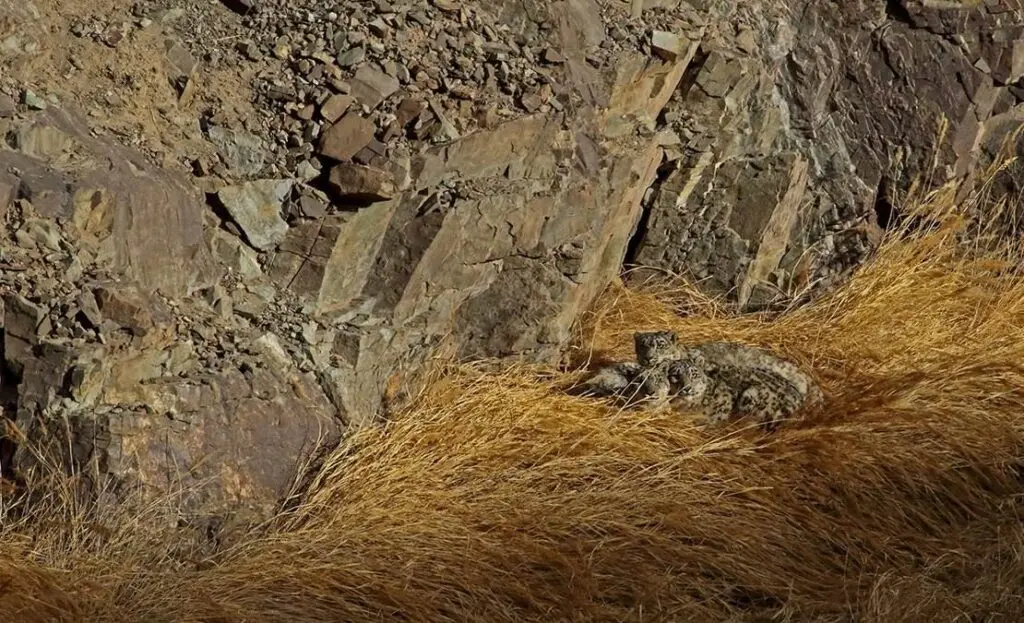
What Other Rare Himalayan Wildlife Will You See on a Ladakh Tour?
A snow leopard expedition should never feel like a binary pass-or-fail test where you stare at barren rock for eight hours a day and ignore everything else. When you travel with a trained naturalist rather than just a transport driver, the entire Trans-Himalayan food web comes into sharp focus.
01 Which High-Altitude Mammals Share the Snow Leopard's Habitat?
Every morning in the field begins by locating the ungulate herds, because their posture tells us immediately whether a predator is nearby. When blue sheep stand rigid, staring uphill and stamping their forelegs with sharp whistling snorts, we know a cat or wolf is moving through the rocks.
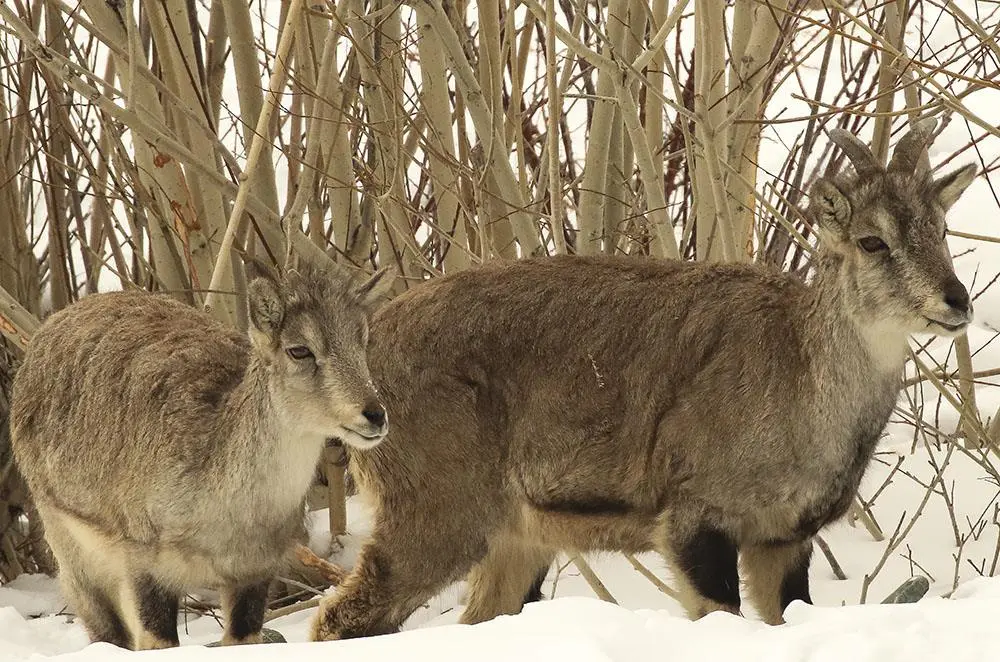
- Bharal / Blue Sheep (Pseudois nayaur): The primary prey of the snow leopard in Hemis and Rumbak; masters of sheer cliff terrain whose slate-blue winter coats blend into shale slopes.
- Asiatic Ibex (Capra sibirica): Stocky wild goats with sweeping, ridged horns found on rugged crags along the Ulley and Indus corridors.
- Ladakhi Urial / Shapu (Ovis vignei vignei): An endangered wild sheep endemic to the Indus and Shayok river valleys, often spotted on lower gravel slopes en route to Ulley.
- Great Tibetan Sheep / Argali (Ovis ammon hodgsoni): The largest wild sheep in the world, occasionally encountered in the higher eastern reaches of Hemis and Gya-Lato.
- Tibetan Wolf (Canis lupus chanco): Pale-coated, thick-furred apex pack hunters of the high plateau that patrol the wider valley floors.
- Himalayan Red Fox (Vulpes vulpes montana): Frequently seen hunting pikas and woolly hares in the snow; in winter they grow a dense chestnut-and-silver coat with a thick white-tipped brush tail.
For mammal enthusiasts looking to expand their Trans-Himalayan checklist beyond winter, eastern Ladakh (Changthang) is also the stronghold of the elusive Pallas's cat (Otocolobus manul), Tibetan sand fox, and kiang (Tibetan wild ass), which we cover on our dedicated Pallas's Cat Tailor-Made Expedition.
02 What Himalayan Birds Can You Spot in Winter and Summer?
As an ornithologist, some of my favourite hours in Ladakh happen on Day 2 of our itinerary, when we drive to the Gya and Lato valleys and walk the shingle banks of the unfrozen Indus River to acclimatise. Even in the middle of February, the birdlife is remarkable.
Along the braided rapids of the Indus, we scan the rounded cobbles for the Ibisbill (Ibidorhyncha struthersii), using its crimson, down-curved bill to probe beneath stones for aquatic larvae, often alongside the Solitary Snipe. Overhead, Lammergeiers (Bearded Vultures) with nearly three-metre wingspans ride the cold valley thermals, dropping marrow bones onto rock slabs to crack them open. On the rocky scree slopes, the haunting whistle of the Tibetan Snowcock and the cackling calls of Chukar and Tibetan Partridges break the morning silence, while summer and autumn expeditions to Tsomoriri and Hanle reveal breeding Black-necked Cranes.
— Aly Rashid, Founder & Naturalist Expedition Leader, Just Nature Expeditions
How Does a 10-Day Ladakh Snow Leopard Expedition Itinerary Work?
Many budget tours compress a Ladakh trip into 6 or 7 days, rushing guests straight from Leh airport into 4,000-metre valleys on Day 2. That shortcuts two things you can never afford to compromise in the high Himalayas: your physiological acclimatisation and the number of full dawn-to-dusk days you have on the scopes.
On our 10-day Snow Leopard Ladakh – 2027 guided tour (limited to a maximum of 6 guests), we structure the pace deliberately around altitude safety and maximum field time:
- Day 1 — Arrival in Leh (3,500m) & Complete Rest: Early morning flight from New Delhi to Leh. Transfer to the heated comfort of The Grand Dragon Ladakh. Mandatory rest, hydration, and pulse-oximeter checks to initiate high-altitude adaptation.
- Day 2 — Acclimatisation Wildlife Drive to Gya, Lato & Indus River: A gentle full-day vehicle excursion at Leh's elevation band to scan for Blue Sheep, Bearded Vultures, Golden Eagles, and Tibetan Partridges, followed by an afternoon walk along the Indus River bank for the rare Ibisbill and Solitary Snipe. Overnight at Grand Dragon Ladakh.
- Day 3 — Leh to Zingchen Gorge & Entry into Rumbak (Hemis National Park): Drive past Phey Bridge along the Indus to Zingchen Gorge, entering Hemis National Park. Scan cliff bases for scent sprays and scrapes as we ascend to our Rumbak homestay for the first of six nights in the wilderness.
- Days 4 to 8 — Five Full Days of Intensive Snow Leopard Tracking in Rumbak & Hemis: Pre-dawn starts with our elite Ladakhi spotters and Just Nature naturalist leader. Hot lunches are served directly in the field at our active scanning locations so we never abandon a sighting window. Track Snow Leopards, Tibetan Wolves, Argali, and Bharal across Rumbak, Husing, and Tarbung.
- Day 9 — Descent from Urutse / Rumbak to Zingchen & Return to Leh: Slow morning tracking descent down the gorge to Zingchen for a hot lunch, followed by a transfer back to The Grand Dragon Ladakh in Leh for hot showers and a celebratory farewell dinner.
- Day 10 — Departure from Leh to New Delhi: Morning transfer to Leh Airport for your onward flight home.
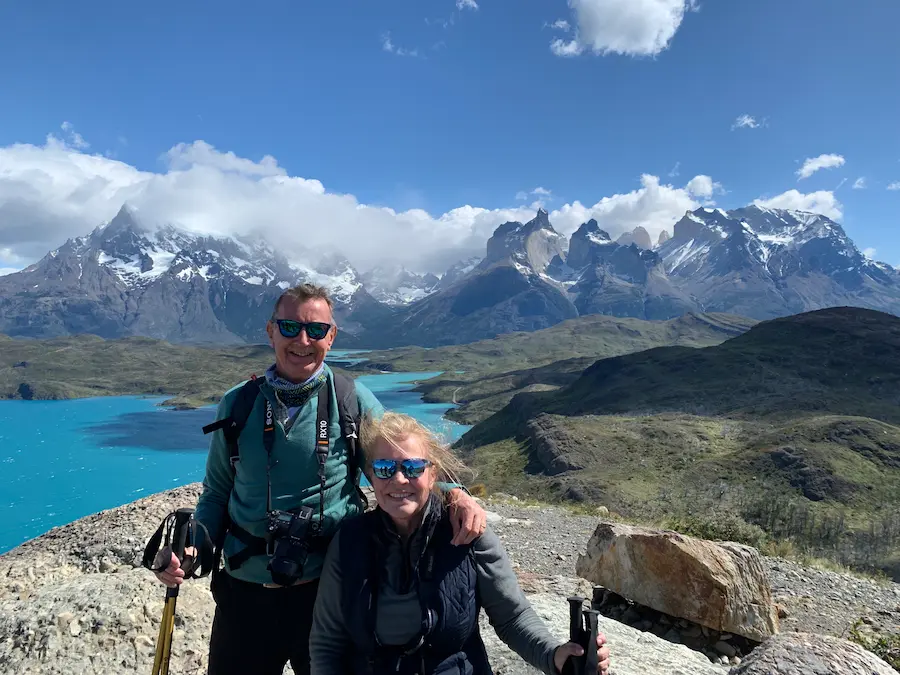
— Heather and Mark Martyn-Fisher, United Kingdom (Just Nature Expeditions Guests)
How Much Does a Snow Leopard Tour in Ladakh Cost and What Shapes the Experience?
When evaluating Ladakh tour packages, looking only at the per-day price tag can be misleading. In sub-zero winter conditions at 13,000 feet, logistics are not a luxury—they are what keep you healthy enough to stay in the field when a snow leopard appears.
As we explain in our guide on how to choose a wildlife expedition operator in India, standard travel agencies simply subcontract a local taxi and a homestay room, leaving you without a dedicated spotter network or ecological interpretation. Here is how the three main tiers of Ladakh snow leopard tours compare:
| Expedition Feature | Budget Backpacker Group Trek | Just Nature Small-Group Expedition | Private Tailor-Made Photo Safari |
|---|---|---|---|
| Group Size | 10 – 16+ participants | Strictly capped at Max 6 guests | 1 – 4 private guests (Custom dates) |
| Leadership & Spotters | 1 local trekking guide shared across the whole group | Founder/Senior Naturalist + dedicated Ladakhi master spotters & scopes | Private Naturalist Leader + dedicated spotter team scouting multiple valleys ahead |
| Leh Base Hotel | Basic guesthouse (limited heating) | The Grand Dragon Ladakh (5-star centrally heated luxury, 3 nights) | The Grand Dragon Ladakh + private heated lodges in Ulley / Rumbak |
| Field Meals & Logistics | Packed cold lunches; fixed walking schedule | Hot lunches served at active spotting sites; all inner-line & wildlife permits included | Custom vehicle positioning, dedicated porters for 600mm camera rigs, flexible valley shifts |
| Camera Gear Support | None | In-field photography mentorship + 1 still camera permit included + rental access | Full telephoto lens & mirrorless body rental options + dedicated camera porters |
How Do You Prepare for Altitude and Sub-Zero Cold in Ladakh?
For a deeper technical breakdown of field preparation, you can read our Snow Leopard Ladakh Complete Expedition Guide and my personal field journal on my first snow leopard sighting. Before you pack your bags for Leh, keep these four non-negotiable field rules front and centre:
- Respect the 48-Hour Leh Acclimatisation Rule: Acute Mountain Sickness (AMS) does not care how fit you are at sea level. Do not exert yourself on Day 1, drink 3 to 4 litres of warm water and soup daily, avoid alcohol during the first 72 hours, and consult your physician prior to travel regarding preventative altitude medication such as Acetazolamide (Diamox).
- Dress for Stationary Cold, Not Hiking Heat: Walking up Zingchen Gorge warms your core quickly, but standing motionless behind a tripod in a -15°C canyon breeze for four hours will chill you to the bone. Layer heavyweight merino wool under a high-loft fleece, a down mid-jacket, and an expedition-grade 800-fill down parka with windproof outer shell trousers.
- Protect Your Hands, Feet, and Eyes: Wear thin touchscreen liner gloves inside heavy down mittens so you never touch frozen metal tripod legs or camera dials with bare skin. Pair sub-zero rated boots with merino socks and toe warmers, and wear UV400 polarised sunglasses to prevent snow blindness.
- Bring Serious Reach (or Rent It): Snow leopards are photographed across wide gorges where 400mm to 600mm focal lengths shine. Lithium-ion batteries lose charge rapidly at -20°C, so carry three spares in an inside chest pocket. If you do not own a super-telephoto prime lens, book one through our Just Nature Camera Rental service.
Frequently Asked Questions About Ladakh Snow Leopard Tours
Which month is best for a snow leopard tour in Ladakh?
What is the sighting success rate on a Ladakh snow leopard expedition?
Should I choose Rumbak (Hemis National Park) or Ulley Valley for snow leopards?
How cold does it get in Ladakh during snow leopard season?
How many days do you need for safe acclimatisation in Leh before tracking?
What camera lens is required to photograph snow leopards in Ladakh?