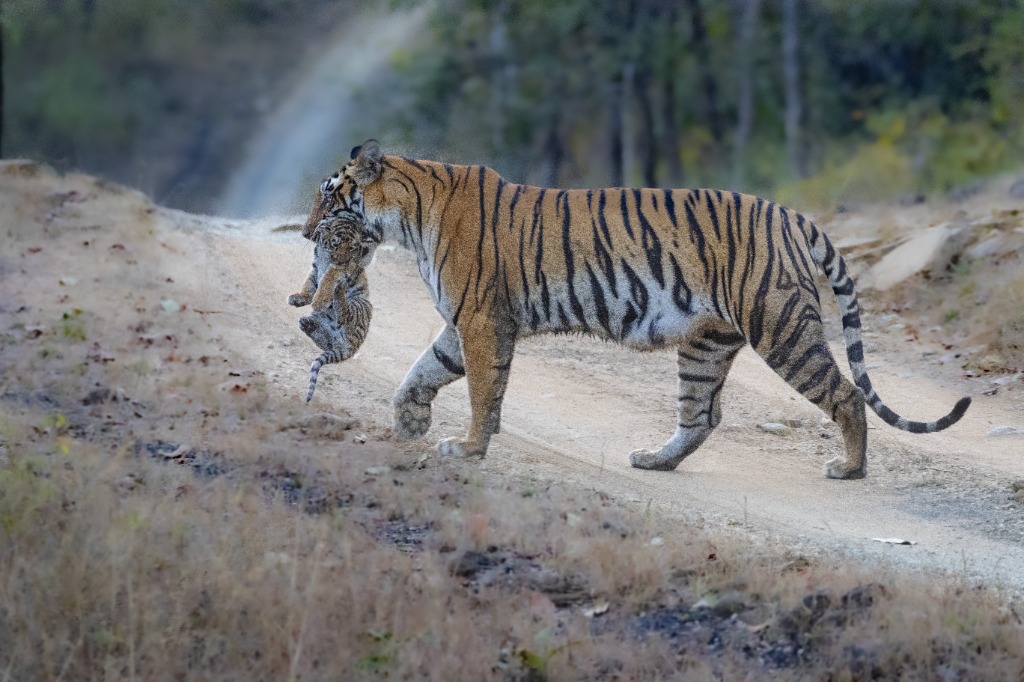
Watch a wild tigress pause at the edge of a bamboo thicket before she decides whether to carry her four-week-old cub across an open forest road, and you will learn everything you need to know about wildlife tourism in thirty seconds. Before stepping out of cover, her ears swivel forward like radar dishes. She is not merely checking for rival males; she is measuring the acoustic and spatial pressure on the track ahead. When our single open 4x4 gypsy sits forty metres back with the engine switched off and only three silent observers holding their breath inside, her shoulders drop. She lifts the cub gently in her jaws and walks straight across the sunlit dirt. Had four packed vehicles roared around that corner with eighteen excited voices carrying through the sal trees, she would have vanished backward into the bamboo before anyone knew she was there. When travellers search for a small group wildlife tour India experience, they often assume group size is about personal comfort. In the bush, group size dictates what the forest is willing to show you.
Table of Contents
- The Behavioural Science of Silence: How Group Size Alters Animal Behaviour
- The Mathematics of an Indian Safari Gypsy: Why 2 to 3 Guests Per Vehicle Changes Everything
- Field Agility and Decision Speed: Anticipating the Forest Instead of Following the Crowd
- On Foot in the Himalayas and Cloud Forests: Where Small Groups Are Non-Negotiable
- For Wildlife Photographers: Sightlines, Stability, and 1-on-1 Field Mentorship
- Lower Ecological Footprint & Deeper Community Impact
- Small-Group Fixed Departures vs. Private Tailor-Made Safaris: Which Should You Choose?
- Who Leads Our Small-Group Expeditions
- Frequently Asked Questions
The Behavioural Science of Silence: How Group Size Alters Animal Behaviour
Spend a decade tracking wildlife across India, as Erwin D'rose, Shivraj, and I have done from the sandstone valleys of Satpura to the high-altitude ridges of Ladakh, and you begin to divide sightings into two completely different categories. The first is what we call a census sighting: you see an orange flank or a spotted tail disappearing into dense lantana for four seconds because ten vehicles converged on an alarm call at once. Technically, you saw a tiger. Experientially, you witnessed an animal escaping human commotion.
The second category is a behavioural sighting. You watch a dominant male tiger scent-mark every third sal trunk along a fireline for thirty-five minutes, flehmen-curling his upper lip to read chemical messages left by a tigress the night before. You watch a mother sloth bear in Satpura dig open a termite mound while two cubs tumble over her back. You watch an Indian leopard on a granite dome in Jawai groom its paws as the desert sun drops below the horizon.
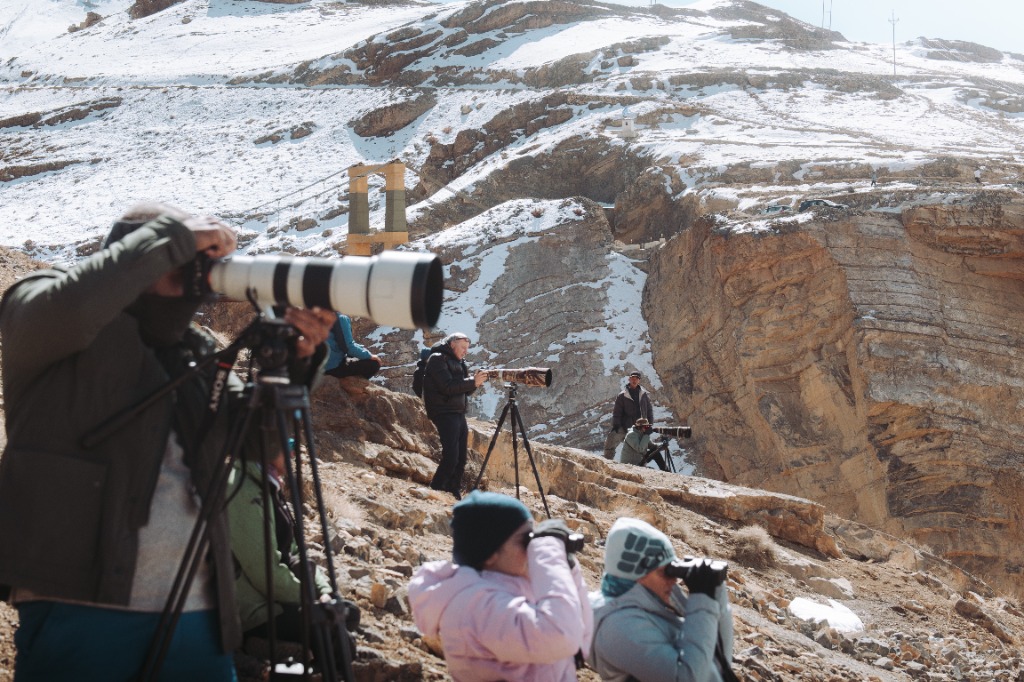
What separates a four-second retreat from a forty-minute behavioural encounter? Almost invariably, it is the acoustic and visual footprint of the observers. Wild animals constantly weigh energy expenditure against perceived threat. One or two quiet vehicles holding a respectful buffer distance, or five disciplined trackers sitting motionless in earth-toned jackets along a Himalayan ridge, register as background neutral. A large tour group arriving in a convoy of four packed jeeps, with whispered conversations multiplying across twenty people and camera lenses clanking against roll bars, crosses the animal's stress threshold almost immediately.
| Field Parameter | Just Nature Small-Group Expedition (6–8 Guests Max) | Standard Commercial Group Tour (14–20+ Guests) |
|---|---|---|
| Guests Per 4x4 Safari Gypsy | Strictly 2 to 3 guests per vehicle (every guest gets a dedicated window/side position) | 5 to 6 guests packed per vehicle (two guests trapped in middle seats with blocked views) |
| Acoustic & Behavioural Impact | Near-zero noise; animals remain relaxed and continue natural hunting or maternal behaviour | Multi-vehicle convoy noise and movement frequently cause shy species to retreat into cover |
| Park Permit & Zone Cohesion | Entire group secures permits in the same prime core zone and travels together | Quota limits force large groups to split across 2 or 3 different park gates and zones |
| Tracking Agility in the Field | Instant pivots when an alarm call rings out or fresh pugmarks are found on a side track | Slow convoy coordination; vehicles default to waiting at crowded main-road sighting spots |
| Photographic Stability | Minimal chassis vibration; ample room for beanbags, tripods, and 400mm–600mm telephoto glass | Constant vehicle bounce as 6 passengers shift weight; no space for long lenses in centre seats |
| Naturalist Access & Mentorship | Direct, continuous dialogue and 1-on-1 camera coaching with Aly Rashid, Erwin D'rose, or Shivraj | Lead guide rotates between multiple jeeps; most drives rely solely on a roster park driver |
| Lodge & Ecosystem Footprint | Fits seamlessly into intimate 8-to-12-cottage conservation lodges and village homestays | Requires large 50-to-80-room commercial resorts outside prime wilderness corridors |
The Mathematics of an Indian Safari Gypsy: Why 2 to 3 Guests Per Vehicle Changes Everything
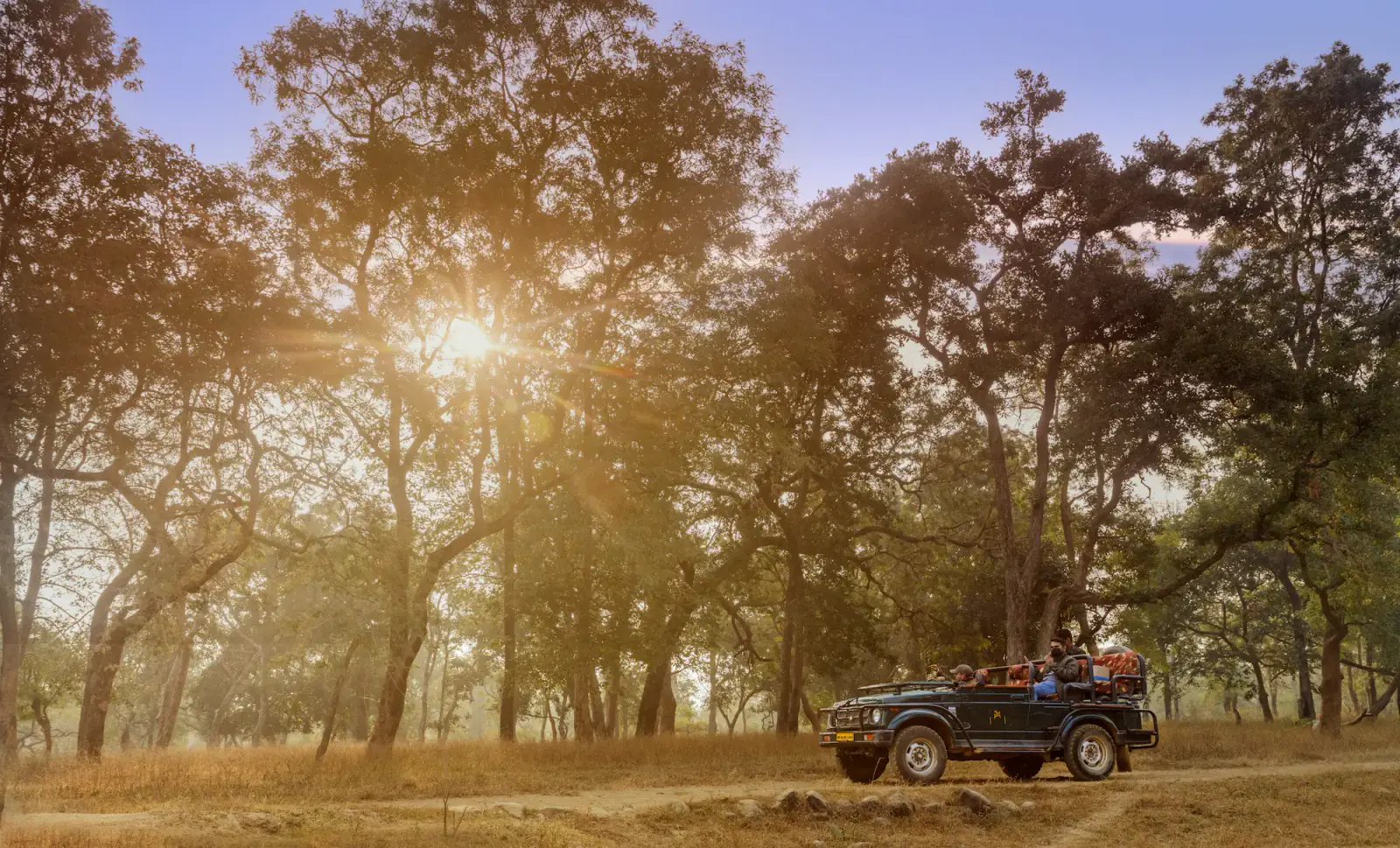
Let us talk honestly about the physical geometry of an Indian safari vehicle, a detail that glossy travel brochures conveniently omit. Across almost every premier reserve in Central India, whether you are tracking in Kanha, Bandhavgarh, Pench, Satpura, or Panna, the official forest department safari vehicle is the open-top 4x4 Maruti Gypsy.
Up front sit the driver and the mandatory forest department guide. Behind them are two elevated bench rows. Legally, a park permit allows up to six tourists to squeeze onto those two benches, three across the middle row and three across the back row. Because permit fees and vehicle hire in Madhya Pradesh and Maharashtra are charged per jeep rather than per person, mass-market tour operators maximize their profit margins by filling all six seats in every vehicle.
If you have ever sat in the middle seat of a six-passenger Gypsy with a camera in your lap, you know how frustrating that economy becomes the moment a tiger appears. You cannot rest a beanbag on the side rail because two other shoulders are blocking both sides of the vehicle. Whenever the cat walks from left to right, six adults stand up and twist at once, rocking the leaf-spring suspension so violently that nobody on board can shoot a sharp frame below 1/1000th of a second.
On every Just Nature fixed departure, such as our 12-day Tigers Unlimited expedition, our 9-day Satpura Explorer, or our Panna Expedition, we cap our vehicles at 2 to 3 guests per 4x4 gypsy. Every single guest has unobstructed 360-degree shooting clearance, space to lay out two camera bodies and a beanbag on the padded roll bar, and the freedom to pivot silently without bumping elbows.
Field Agility and Decision Speed: Anticipating the Forest Instead of Following the Crowd
There is a second structural reason why large group tours struggle in Indian national parks: the core-zone permit quota system. As we detail in our Bandhavgarh vs Kanha vs Pench comparison guide, each core gate in Central India releases a strictly limited number of vehicle permits per shift when bookings open 120 days in advance.
When an international tour company sells a 16-person departure, securing four or five core permits for the same prime zone (such as Kanha's Mukki or Kanha zone, or Bandhavgarh's Tala and Magadhi zones) on the same morning is nearly impossible. In practice, half the group ends up booked into a secondary gate while the tour leader rides with the other half miles away.
By capping our guided expeditions at 6 to 8 guests total (just two vehicles), we secure unified access to the exact zones where seasonal predator activity is strongest. More importantly, two vehicles can operate with tactical precision in the field. When Erwin D'rose hears the sharp, metallic kok-kok alarm call of a langur troop echoing from a wooded ravine in Kanha, he does not have to shepherd a caravan of five jeeps down a narrow track. We make an immediate, quiet decision, position at the predicted exit meadow before any crowd forms, and let the cat walk straight toward us.
On Foot in the Himalayas and Cloud Forests: Where Small Groups Are Non-Negotiable
If small groups are a major advantage in a safari jeep, they become an absolute ecological necessity the moment your boots touch the ground. Across several of Just Nature Expeditions' signature journeys, there are no safari vehicles between you and the animal:
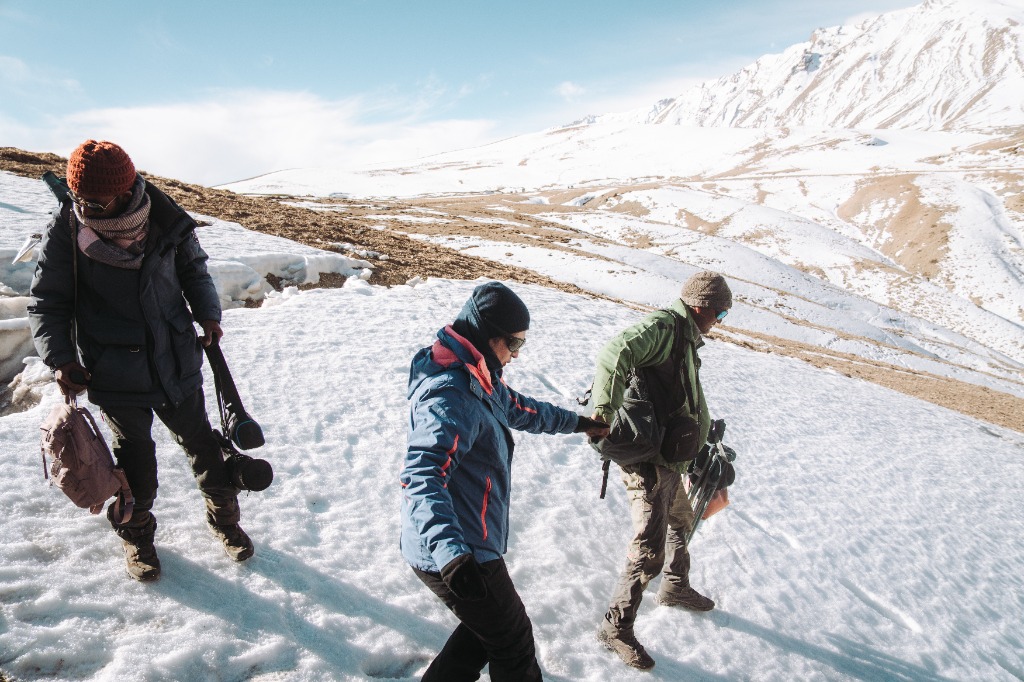
Whether you track in Kibber or Hemis (which we compare in depth in our Spiti vs Ladakh snow leopard guide), searching for Panthera uncia at 13,000 to 14,500 feet requires sitting along narrow, wind-scoured rock ledges while scanning opposite gorge walls with spotting scopes. Six guests can tuck low behind a stone ridge line without skylining themselves or spooking a herd of blue sheep (bharal) grazing below. A noisy line of eighteen trekkers crunching across frozen scree will send both the prey herd and a stalking snow leopard over the crest in minutes.
In the misty 10,000-foot bamboo and rhododendron forests of the Indo-Nepal border on our Red Panda Expedition, the trails are barely four feet wide. When our local trackers locate a wild red panda feeding on ringal bamboo leaves in a narrow canopy window, there is physical space on the trail for only six to eight observers to set up tripods at an ethical distance. Any larger group forces half the travellers to wait behind dense bamboo out of sight, or worse, crowds the tree base until the animal abandons its feeding perch.
As we explain in Satpura's Super Six: A Naturalist's Deep Dive, core-zone walking safaris inside Satpura Tiger Reserve are legally restricted by the forest department to small, disciplined parties for both safety and silence. Similarly, during our monsoon herping expeditions in Amboli in the Western Ghats, photographing a camouflaged Malabar pit viper on a rain-slicked fern frond at night requires a tight, careful circle of four to eight macro photographers taking turns without trampling the delicate forest floor.
For Wildlife Photographers: Sightlines, Stability, and 1-on-1 Field Mentorship
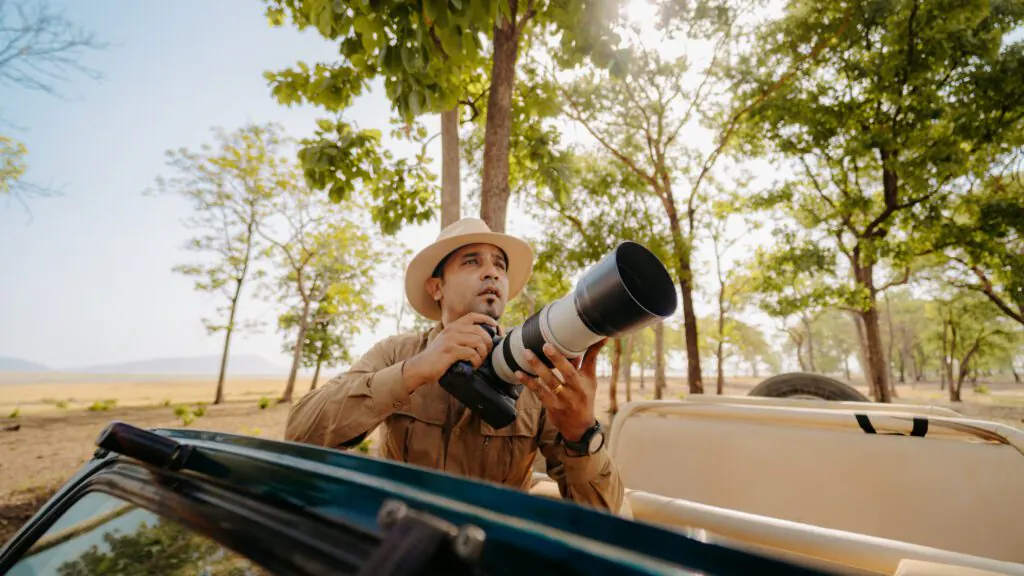
Many of our guests travel with serious camera gear, or hire pro-grade bodies and super-telephoto lenses through our Camera Rentals by Just Nature Expeditions programme. When our resident wildlife photographer Shivraj mentors guests in the field, he points out that the difference between a portfolio-grade image and a soft, cluttered snapshot usually comes down to how the vehicle is managed during the sighting:
- Aligning the Vehicle for Every Guest's Lens: With only 2 to 3 photographers in a jeep, our driver needs to move the vehicle by just two feet so that every person on board has a clean gap through the foliage at eye level. In a packed six-person jeep, at least two people are always shooting through branches or over the driver's roofline.
- Rock-Solid Stability in Golden and Blue Hour: The most magical light in the Indian jungle happens in the first twenty minutes after dawn and the final fifteen minutes before dusk, when shutter speeds often drop to 1/160s or 1/250s even at high ISO. With two or three disciplined shooters resting beanbags on the frame, the vehicle stays dead still during silent electronic shutter bursts.
- Patience to Wait for the Decisive Behavioural Frame: Large groups on rigid schedules tend to tick off a sleeping tiger after ten minutes and drive away to keep the crowd moving. In a small group of dedicated enthusiasts, we are happy to sit quietly with a single leopard on a granite ridge in Jawai for ninety minutes until it stands, stretches into the golden light, and begins its evening descent.
- Live In-Field Camera Coaching: Because our expedition leaders are sitting right beside you rather than managing twenty people across four jeeps, we can whisper immediate exposure compensation adjustments (such as dialing down
-1.0 EVwhen a dark sloth bear steps into a bright shaft of morning sun) while the action is unfolding.
"In wildlife photography, patience and positioning beat megapixels every single morning. You cannot practice patience when six people are fighting for two feet of roll-bar space."
Lower Ecological Footprint & Deeper Community Impact
When we founded Just Nature Expeditions in 2022, we built every itinerary around a simple commitment: Immerse in extraordinary wildlife moments while treading lightly on the environment. That philosophy is not separate from sighting quality; it is the foundation of it.
Fragile ecosystems cannot absorb industrial tourism numbers without losing the very wilderness character you came to experience. By keeping our departures capped at 6 to 8 guests, we deliberately stay small enough to partner with conservation-focused lodges and community homestays that large bus tours can never use:
In Satpura, we base ourselves at intimate properties like Reni Pani Jungle Lodge and Bori Safari Lodge, where native forest trees grow right between the cottages and nocturnal wildlife walks past your veranda. In Spiti Valley and Ladakh, our small footprint lets us stay in warm, family-operated village homestays in Kibber and Ulley, ensuring that the economic reward of preserving snow leopards goes directly into the hands of the local herding families who share their mountains with big cats. On our international departures, such as our 2027 Jaguars of Pantanal Expedition in Brazil, a 6-to-10-guest cap allows us to moor right inside Jaguarland in the Jaguar Suites and spend unhurried evenings at SouthWild Pantanal observing wild ocelots without disturbing them.
Small-Group Fixed Departures vs. Private Tailor-Made Safaris: Which Should You Choose?
When guests reach out to plan an expedition with our naturalist team, they generally choose between two ways of traveling:
You are a solo traveller, couple, or wildlife photographer who wants to step onto a meticulously pre-planned expedition during the absolute peak seasonal window, with prime core permits and lodges already locked in and a small circle of like-minded companions sharing the campfire each evening. You can browse all of our upcoming fixed departures on the Guided Tours hub, covering Tigers Unlimited, Satpura Explorer, Snow Leopard Spiti and Ladakh, Red Panda Singalila, and Jaguars of Pantanal 2027.
You want complete control over your travel dates, lodge selection, daily pace, and exclusive 4x4 vehicle occupancy for yourself, your partner, your family, or your private photography group. Our Tailor-Made Safaris portfolio, including our 16-day Luxury Wildlife Holiday in India, 14-day Big Cats of India Expedition, and 5-day Jawai Leopard Safari, pairs private wilderness access with dedicated founder or senior naturalist leadership.
Who Leads Our Small-Group Expeditions
As we emphasise in our guide on how to choose a wildlife expedition operator in India, a small group is only as effective as the naturalist reading the forest at the front of it. Meet the three field leaders who personally accompany our expeditions across India and the world:
- Aly Rashid (Founder & Naturalist Expedition Leader): Trained naturalist and ornithologist, 7+ years heading the naturalist team at Reni Pani Jungle Lodge in Satpura, caracal researcher in Panna National Park (2014), and author of Tales from the Bush: A Peek into the World of Satpura.
- Erwin D'rose (Senior Naturalist & Expedition Leader): Five years studying tiger behaviour in Kanha National Park followed by more than eight years as a senior naturalist and lodge manager in Satpura, bringing unmatched big-cat tracking intuition to every small-group departure.
- Shivraj (Naturalist & Wildlife Photographer): Over 12 years of field tracking experience across Central India, trained alongside African safari guides, and dedicated mentor for ethical wildlife photography and vehicle positioning.
Read the complete profiles of our team on the Expedition Leaders page.
Frequently Asked Questions
What is the maximum group size on a Just Nature Expeditions guided wildlife tour?
How many guests do you put in each 4x4 safari jeep in Indian tiger reserves?
Why do small group wildlife tours produce better animal sightings than large groups?
Are small group wildlife tours in India suitable for solo travellers and beginner photographers?
How far in advance should I book a small group wildlife tour in India?
Can I book a private version of any Just Nature small-group itinerary?